Monday, June 13, 2005

SHAKEN, NOT BROKEN

I spent last weekend with my family in Madison, Wisconsin. While none of us actually live in Madison, at least two or three of us will be there over the next month or two.

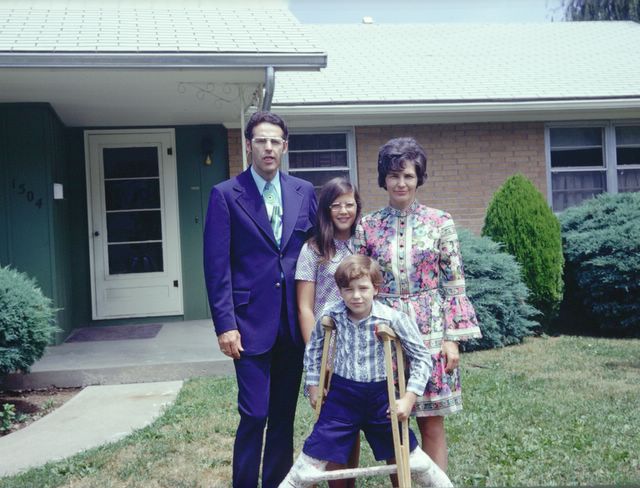
Nearly 30 years ago, aboard the U.S.S. Lexington, Rick was coming up a ladder at the same time a hatch was coming down. Hatch met head and the result has been three decades of increasingly debilitating seizures. After marrying an incredible woman (my sister), and trying every kind of therapy and medication available, he was accepted as a candidate for a temporal lobectomy at the VA hospital in Madison. He begins with a procedure tomorrow that is designed to open the skull and insert a device designed to make intracranial EEG recordings that are then used to determine exactly where the surgery should be performed. He could emerge seizure-free, but there are obvious risks. It's brain surgery.

Rick has a talent for changing the way those around him view the world. Mostly, he messes with you by refusing to engage in predictable conversation. He is always ready with a one-liner or an odd perspective, delivered in his droll near-mumble. He never responds, "I don't know" to a question. Maybe, "Don't make me lie to you," but never a conventional reply.

If someone begins to rub his shoulders, he is likely to give them the sharp rebuke, "You have exactly 30 minutes to stop that."

And if you mistakenly drink from his water glass, expect to hear, "Don't worry about it, these sores mean nothing."

He is partially responsible for turning me from an insufferably self-righteous apologist to a rhetorical beggar that masquerades a little less frequently as a Pharisee. One summer afternoon, about 20 years ago, when I was at the height of my "I-got-me-some-religion-and-it's-better-than-yours" stage, he stood in my parents' kitchen and declared, "It's not what you're saying so much as how you're saying it." He was right, and I started making changes. I use that line with my students now.

I even wrote a song about him, that will be on a new CD (available soon).

I have a brother who lives down south
He's taking it on the chin
The rug was pulled out from under him
He doesn't know where to begin
He doesn't know
What he's gonna do

His hands are as rough as Mexico
And his dreams are falling flat
He lives next to a Texaco
He swears he'll make it back
To where he wants to be
Sometimes he doesn't see

That he's shaken, not broken
Taking the things unspoken
And making them true
And with a heart as big as Texas
He'll make room for you

He wanted to teach like anything
But the seizures get him down
He likes to hear Bob Dylan sing
And he knows where he's bound
If he weren't around
I don't know what I'd do

Well, he's shaken, not broken...

He smokes without a filter
And he loves without reserve
When things are out of kilter
He's got a belly full of nerve
To do the math
Off the beaten path

Well, he's shaken, not broken...


Saturday evening I stood with Rick on the shores of Lake Mendota, having a chat while he smoked one of his trademark unfiltered Camels. It was a good talk, but what struck me about it was the utter lack of desperation or avoidance. There was no anxiety about the conversation. We had always been honest with each other, and we had never witheld affection on account of machismo. There was no call for a relational crescendo. We had reached fortissimo with a fermata...no stopping us until the Conductor directs otherwise. It was a good way to leave him.

I had no end-of-life epiphanies. I don't think you should have to "live like you are dyin'." You don't need to go skydiving, or Rocky Mountain climbing, or try to go 2.7 seconds on a bull named Fu Manchu. You just need to live with the kind of reckless passion and honesty that, when you face the end, leaves you strangely, yet comfortably, quiet.

Before we left Madison, I took a couple of shots with the digital camera. I wasn't fooling anyone. The pictures were to preserve his image for us, should he not survive the surgery. Rick just grinned and said, "Ahhh, Americans and their gadgets."
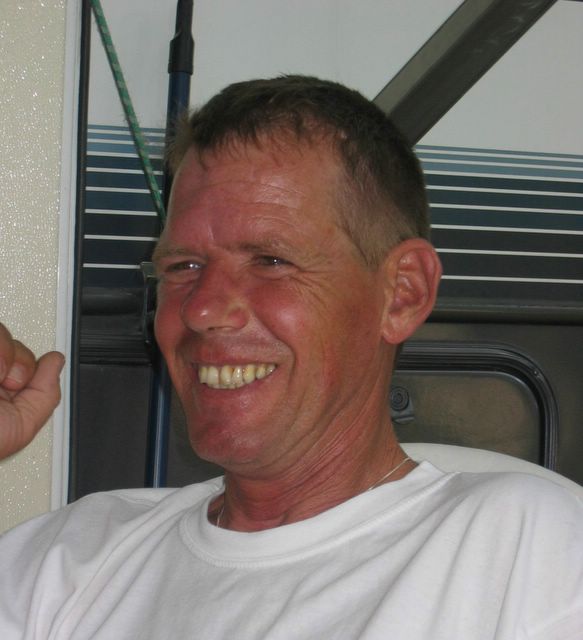


Gadgets indeed.

Tuesday, June 07, 2005

STUCK INSIDE A LANDFILL WITH THE STRANGER BLUES AGAIN

The worst part about home remodeling, besides paying for it, is hauling off the debris. There is a certain catharsis in taking a sledge hammer to plaster, and opening up future possibilities. You are making change, and it is dramatic. There’s nothing like the look on your family’s faces when they come home to find that the living room wall, whose existence they had come to assume, is now only a memory. But the task of cleanup isn’t nearly as romantic.

Some months ago, in the midst of our kitchen remodel job, I had a small demolition load that wasn’t quite large enough to warrant a trip to the dump; so I offered some trailer space to my neighbor, Allen. He took me up on it, and we headed off for one of the local landfill transfer stations.

The transfer station is the place trash stops before its final destination. It is the descending colon of the city’s solid waste system. The station I frequent is a loud, foul-smelling barn with a drainage problem and lots of pigeons. If there’s been any measurable precipitation, you can count on wading ankle deep in detritus. There is a rhythm and an unspoken protocol about the place.

  1. Pull on the scale.
  2. Wait for Hank, the sanitation worker with the sunny disposition, to look at you like you are an idiot.
  3. Register your weight, and wait for Hank’s coveted nod of approval to enter the abyss.
  4. Pull into the bowels of the place and unload quickly, while Hank and the guys in the big scary trucks look at you like you are an idiot.
  5. Somewhere in here make several attempts at backing a trailer, while veteran truck drivers scoff, and the incessant warning alarms from reversing front end loaders add to your anxiety.
  6. Drive around and have Hank weigh you again to determine your payment by how much lighter you are. Oh, yeah, while he's looking at you like you're an idiot.
  7. Speed away from the place with the windows down.
  8. Go home and take a China Syndrome shower.

My neighbor, Bill, taught me a nifty drag-off method that reduces time, effort, and disdainful looks from mean trash guys. You attach a chain to some big piece of debris, located near the bottom of the pile toward the front of the trailer. Hook the other end of the chain to the station’s wall, then pull away carefully. If you planned well, this method deposits the majority of your load on the station floor, allowing you a quicker getaway.

On this particular day, Allen and I executed a perfect drag-off, and were back in line for the scale to finish our business. In front of us was an obvious first-timer. He was an older gentleman driving an immaculate pickup, and pulling a questionable trailer full of tons of old house guts. He wore a cheery smile and his own personal hardhat. Hank was going to eat this guy alive.

I chatted with him while we waited. I discovered that he was in his late 70s and had recently undergone heart surgery. The load was from his son’s remodeling project, but he had needed the trailer, so he had offered to deliver it. I helped him navigate the weighing and paying method, all the while wondering how he was going to empty that trailer. I couldn’t let this heart patient suffer the risk to his health and the scorn of Hank, so after consulting with Allen, I offered our help.

He had rigged a drag-off design that managed to dislodge about 20 pounds of the load. The remaining mountain of wet plaster, lath, and insulation proved to be a stubborn burden. After a filthy, exhausting half-hour or so, Allen and I finally emptied the trailer and swept it clean. We turned to go, and the old man pulled out his wallet and started to hand me a five-dollar bill.

“No sir, I won’t take your money,” I said. “We’re all in this together.”

He pushed the money toward me, while his body began to shake in his attempt to choke back the tears. I just patted him on the shoulder and said, “You would do the same for me, if I needed it.” And I turned and walked away, I heard him stifle a sob. I didn’t want to cause him further loss of face, but I was not going to accept payment for doing the right thing.

I guess I turned and left quickly because of the shame. Not the shame he felt, as a man unable to deliver his own load, but the shame I felt for living in a culture where something like this could happen. Where the hell was this guy’s son? Where were his neighbors? Were they unavailable or unwilling? Were they unaware, because he had been too proud or naïve to ask for help?

What impacted me the most was the fact that we live in a society where sacrificial help provokes a grown man to tears. Allen and I didn’t feel like we had done anything heroic or extraordinary. But it was such an uncommon act it overwhelmed him.

Something is wrong. We can do better than this.

To paraphrase Dylan,

Oh, Mama, can this really be the end?
To be stuck inside a landfill
With the stranger blues again.

I’m not suggesting that we should all be imbued with a sense of entitlement, expecting everyone to solve our problems; but we have become so addicted to individualism and market-driven values that we have lost the capacity to accept grace. As a consequence, we dispense less of it as well.

Do you agree that part of our problem today is the inability to accept authentic grace (help, love, mercy…) when it’s offered? What can we do about it?

Friday, May 27, 2005

CRASH OF '71 (continued)

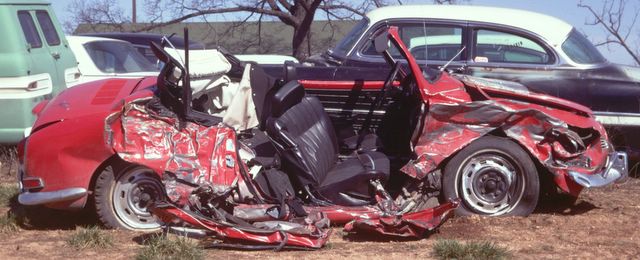
As you saw, the Ghia did not recover; but Dad did. In a few weeks, he was back to his old ways…with one exception: no more little sports cars. As a replacement for the Ghia, he bought a 1970 Lincoln Continental. It was a tank. Anybody attempting to collide with that behemoth would be looking down the mean barrel of some DEEtroit heavy metal.

I, however, was not back to normal. I was left with a bit of a limp. For months after the accident, I hobbled around with pain in my knee and hip.


Nobody was quite sure what to do with me, until a fine man named Jess Gwinn sponsored me as a candidate for treatment at Shriner’s Hospital for Crippled Children in St. Louis.

It was at Shriner’s that I was diagnosed with Perthes and put in a plaster cast to position and immoblize my hip, so it would begin to recalcify and form a healthy new hip bone. The doctors said I would have had the condition anyway. The accident brought it to our attention more quickly, and probably made it worse.


Hot Rod Lincoln 


Oh, Yeah 

I wore the cast for more than two years, traveling to St. Louis for checkups and a new cast every couple of months. It was there, at Shriner’s, where I learned to do tricks in a wheelchair. I met all kinds of deformed and injured children. I felt pretty lucky most of the time. In one of the more bizarre moments at the hospital, Tiny Tim sang “Tiptoe Thru the Tulips” at my bedside.

I walked on crutches for a few months after losing the cast. Fell down the stairs and broke my arm during that period; but that’s another story!

The hip healed. Sorta. I wasn’t Pinocchio; I could walk and run like a real boy. But too much strain on the hip, or a drastic weather change might cause a hitch in my get-along. I was able to play sports, and I developed my own peculiar strut. Kind of like John Travolta with an occasional cob up his ass.

Today, I still have some pain and discomfort. Sometime in the next few years I will have to have a total hip replacement.

What about the stranger?

I turned 40 this year, and I went in search of my narratives. Perhaps it’s my age, but I have come to realize that we are little more than the collection of our stories. So, I asked my parents to tell me about the accident.

It turns out that some of my relatives knew the stranger’s name. We had fallen out of touch with him, but maybe they would know how to reach him. I'm not sure why I wanted to know. I don’t know what I thought I was going to do. I guess I felt like I should go speak to him, thank him for his faith. I suppose part of me wondered if he was real. I have heard lots of stories of people who were rescued or helped in some way, only to find that their savior had mysteriously disappeared.

Jacob wrestled with God, or an angel, and won. At the end of the fight, God renamed him “Israel” and messed with his hip. Gave him a limp. Was this stranger my angel? My god? Was there some message I had missed? What had I become? Who was I supposed to be? Had I wrestled well, or was God still waiting for me to prove myself? I needed to find some kind of answer.

Sometime in 1973, the stranger wrapped his lips around a Smith & Wesson.

I still never found out his name, but my uncle claims to remember the story of the suicide. No one really knows why he did it. Maybe his wife got tired of him living for others and not for himself. Maybe there was no one left to save. Maybe the cumulative weight of all that ferocious love became more than his heart could bear. I don’t know the story. I just know that when I heard it, I wept. I wept for the man I never knew. I wept for the crazy son of a bitch that would pick a strange kid out of a ditch and race for help...to hell with what anyone thought about it.

Do angels kill themselves? I don’t know. Maybe angels don’t just perform beautiful miracles. Maybe they live for awhile and fall hard so we can learn how to live. I know that the stranger’s life has made me learn to not take my rescue lightly. I don’t want to live a life marked by fear or guilt. I want to live a life of gratitude. Ever aware of grace. Whether it be a kid in a ditch, the oppressed outcast, or some poor guy who’s reached the end of his rope. I don’t want to retreat to safety. I want to live with strange passion. I want to pick them up.

I better get a station wagon.

Tuesday, May 24, 2005

CRASH OF '71

I tried to go for a run the other day. We had been experiencing strange weather: cold one day, warm the next...rain, sun, etc. Limping, I returned to the house after just a few blocks. Weather changes do a number on my hip. I suffer from the effects of avascular necrosis of the femoral head, brought on by a childhood case of Legg-Calve-Perthes disease, where the blood supply to the ball joint of the hip is cut off. The hip starts to die, and eventually collapses.

It is particularly acute if you suffer some sort of trauma to the hip.


My dad scandalized some of the church folks when he bought a convertible. It was a sweet ride: a bright red Volkswagen Karmen Ghia. But not everyone at the First Baptist Church of Sedalia, Missouri was ready for their pastor to be tooling around town in a ragtop. I mean, it was 1971, and the culture was being destablized enough by ungrateful little punks like John Kerry questioning the wisdom of war in Southeast Asia, and hippies like John Lennon telling us to imagine no religion. The last thing we needed was to see our preacher in a little German car with the wind in his sideburns.

Well, the public indignity was short-lived.

A few months after he bought the Ghia, Dad and I drove down to Thayer, on the Missouri-Akransas border, to see my grandparents. We had a nice visit, and on the way home we took highway 63 from West Plains to Willow Springs. The top was down and the wind was a sedative. I unbuckled and fell asleep leaning against my dad.

When we came to the dogleg turn near Pomona, an approaching car crossed the centerline and headed right for us. There was no escape on the right; the truckstop entrance offered a blunt abutment. Dad tried to swerve to the left to avoid a head-on collision. No good. The oncoming driver corrected at the same time. We met in the middle, with the other car catching the right front of the convertible, peeling my side of the car like a tin can. If I had been sitting upright, I would have taken the force of the impact.


The paramedics said if Dad hadn’t been wearing his seatbelt, he would have been thrown 50 feet out of the car and killed. But, since seatbelts in 1971 only covered the lap, the same restraint almost cut him in two. When the ambulance arrived, they saw he was in a life-threatening condition and loaded him up for transport. Either they didn’t see me crumpled up under the dashboard, or there wasn’t room for both of us in the ambulance...or maybe they thought my injuries were superficial and that I should just shake it off and walk to the hospital; but for some strange reason, they took off without me. That’s right. Six years old and they left me in the ditch.

Enter the stranger. He was driving a big Plymouth station wagon, and he didn’t like the looks of that situation one bit. Without training, permission, or hesitation, he grabbed my semi-conscious body, stuck me in the back of his wagon, and took off for Ozarks Medical Center.

The stranger was apparently accustomed to lending a hand. The car was mostly full of day-laborers. Nobody wanted them fulltime, so he hired them when he could. And they were black. And it was Southern Missouri in 1971. My world was pretty white.

When I woke up in a strange car, with four strange black men staring down at me, and fire shooting through my legs, I screamed like a motherfucker.

I’m sure we made quite a sight: a 1965 Plymouth Valiant Wagon barrelling down the road toward West Plains — breaking the law, carrying outcasts, and crying out for deliverance. I can just hear the stranger, hunched over the wheel of his renegade ambulance, muttering, “The last shall be first. The last shall be first.” Giving the finger to all the doctors, the bigots, and the careful standersby that would rather watch from safety than dive elbowdeep into the shit. He was a man of faith.

His faith delivered me to the hospital, where I stayed for a week or two.

After our odd separation at the scene of the accident, Dad demanded that we share a room. At first the nurses weren’t going to allow it, until he took a break from spitting up blood and threatened to kick somebody’s ass with a bedpan.

The stranger came to visit once. We thanked him, but over time we were preoccupied with our own recovery and forgot his name. His faith gave way to our reality, as faith so often does.

Although I never saw him again, he recently reentered my life.

(Stay tuned for Chapter 2)

Tuesday, May 17, 2005

THE SPACE BETWEEN

Thanks to those of you that contributed to the latest dialogue. It has been an intense week or so. She went home last weekend. She's doing well. She left the hospital with a steel plate in her jaw and a halo brace holding her fractured neck together. What a tough young woman. I pray that she is able to deal with her emotional wounds as well as she has dealt with her physical condition.

Some of you raised some meaningful and provocative questions. Sorry I didn't engage all of them with my typical vigor and verve. The last few days have been filled with final exam prep and an enormous load of papers to grade. I am always a little stricken with malaise at the end of the spring semester. Don't know why. Perhaps it's the stress. Perhaps it's a little like post-partum depression: separating from something you have nurtured for months. We don't finish finals until the end of this week; then I get to sit through a commencement speech by Majority Whip Roy Blunt.

Huh. Whip Roy Blunt.

Whip Roy Blount.

Me like the sound of that.

I have been escaping paper-grading by watching an occasional film. The first escape was My Dinner With Andre. If you haven't seen this 110-minute film about a dinner conversation, you must. Do it now. I'll wait.

Wasn't it great? Can you imagine having another "So, how was your day?" kind of conversation after that?

If you weren't delighted by the dialogue, at least you had to love the fact that Wallace Shawn actually says "inconceivable" like his Vizzini character in Princess Bride.

The next was a revisitation of Amadeus, the film about Wolfgang Amadeus Mozart, that is really about Antonio Salieri: "the patron saint of mediocrity." He's my saint these days.

Speaking of saints, yesterday it was Luther that spoke to my internal and ongoing catholic-protestant struggle. As Protestant-like Catholic author Walker Percy wrote, "One dead, the other powerless to be born."

Was that random enough for you? Back to grading. Oh, hell, everybody gets an A.

Thursday, May 05, 2005

HUG YOUR DAUGHTERS

I just came from the hospital, where I was at the bedside of an incredible young woman. Beautiful. Smart. Funny. She represents everything that gives me hope for the future. Whether she is speaking out against injustice, performing, or making a smartass comment to one of her annoying professors, she is doing it with style and grace.

Early yesterday evening she was viciously assaulted. She was running on a recently completed biking trail on a warm sunny day in a small Midwestern town: a town that was recently named one of the safest in America. She suffered numerous broken bones, cuts, and bruises, not to mention the kind of physical and emotional injuries I cannot begin to understand.

After spending hours with her and her family last night and today, I have this to say: Men, hug your daughters.

Women, you should hug your daughters too. And all of you should hug your sons as well. And, if you don't have children, hug someone else's kids so they know they are loved.

But most of all, men, hug your daughters. Hug them until they start to wonder why you're still hugging them--until it starts to embarrass them--then hug them some more.

Also, men, if you ever have the urge to say something, do something, or look at something that treats women as anything other than the apple of some daddy's eye...Stop it.

Just stop it.

Friday, April 29, 2005

THE NEW DIALOGUE

Have you ever eaten lunch with a prophet? It’s different than what you would expect. Once you get past the long hair, the locusts, and the camel hair jacket, the utter lack of BS is what draws you in and keeps your attention.

I had the chance to share table with a prophet yesterday. After delivering a lecture to over 400 people at Drury University, bestselling author, Jim Wallis—sans wild hair and bullshit—ate chicken and rice with me…and about 30 others. Wallis was in town to promote his book, God’s Politics: Why the Right Gets It Wrong and the Left Doesn’t Get It, and to declare a message he has been proclaiming for over thirty years as editor of Sojourners magazine and the founder of Call to Renewal. His message was this: “The monologue of the religious Right is over. The new dialogue has begun.”


What’s so important about this guy that he is showing up on The Daily Show, Hannity & Colmes, and PBS? Why is Bono chatting with him; and why are Al Mohler, James Dobson, and Jerry Falwell debating him on talk radio and cable television? Why do the Clintons hang with him; and why do President Bush and Prime Minister Blair consult him on matters of war and poverty? And, most of all, why is Barak Obama having breakfast with this guy next Tuesday?

Perhaps because he is the most important figure in religion and politics at this particular moment in history. What about Benedict XVI and Abu Musab Zarqawi, I hear you asking? Okay, the most important religious figure in the United States. What about Dobson and Falwell? Okay, within the confines of non-theocratic, progressive, evangelical, American I-don’t-want-to-build-an-angry-empire type Christianity, this is the guy.

Why is he traveling around the country like a rock star, with auditoriums and bookstores filling to standing-room only? Because he is saying what so many lack the courage to say. And the truth he speaks to power isn’t part of the polarizing cliches we see in everyday politics and religion. Wallis isn’t claiming the end of the world or threatening liberal judges; he seeks to reclaim the faith that has been hijacked by the religious Right and neglected by the secular Left.

He challenges the Right for claiming ownership of God and setting a public agenda that rarely extends beyond abortion and gay marriage. He points out that since the Bible refers to the poor over 3,000 times, perhaps we ought to make poverty and social justice our number one concern. He asks, “Since when did having moral values make you pro-war, pro-rich, and pro-America only?”

In fact when Dobson and his minions held their Justice Sunday rally last week, where they claimed that Democrats are “against people of faith,” Wallis headed up a counter rally where he pointed that even when Martin Luther King, Jr. chastised the errant clergy his Letter from a Birmingham Jail, he challenged them, but he never questioned their faith.

Admittedly he is easier on the Left. He seems to be more in line with most liberal policies; but in reference to Democratic secularists (like Howard Dean) that are uncomfortable with religion, he says, “We need leaders who at least know that the book of Job is in the Old Testament.” Rather than abandon religion, Wallis argues that the Left should lean in to it.

What he is describing is a prophetic faith that could counter the empire-building religion of the Right. Like Cornel West, Wallis warns against the rhetoric of “Pax Americana.” And, where are the churches? Many of them are lining up to crown the emperor.

Clearly, most churches today are “non-prophet” organizations. Their agenda is set for them by leaders who don’t own Bibles, or clearly haven’t read them in a long time.

There’s more to say, but I am only halfway through the book.

I suppose what I like best about Wallis is his dual commitment to critique and dialogue. What we usually get from social changers is bitter critique followed by self-righteous monologue, or a call to cooperative dialogue that is so anemic it fails to call the power structure to task. He is not afraid to call out the Pharisees and lay some woes on their ass (see Matthew 23); but he cautions against self-righteousness or the cynicism of despair. We have to proceed with hope and commitment to real solutions.

He is not afraid to say, “James Dobson is a theocrat.” But he doesn’t just beat his chest and make SpongeBob jokes. He provides layer upon layer of real solutions for the immorality in our culture that do not include demonizing and directing our collective hate toward a group of people because of their sexual identity.

He is fond of saying, “Churches can’t just keep pulling bodies out of the river. At some point, we need to go upstream to stop whoever is throwing them in.”

Like Wallis, I’m tired of the politics of blame and fear. I’m ready for a politics of hope.

So, yesterday’s lunch was a prophetable experience for me. I don’t have much respect for those (including myself) who smugly condemn the status quo, while doing very little about it. It’s easy for us to beat on a governor for cutting Medicaid, or a president for privileging the rich; but what action are we taking?

Wallis says, “Discussion is not enough. We can’t just sit around in our comfortable homes and pontificate about the condition of the world. We need to be in relationship with the poor.”

Come on, “We are the ones we’ve been waiting for.”

Wednesday, April 13, 2005

SHOWDOWN AT THE R-12 CORRAL

The schoolmarm delivered some shots (scroll down about 4 paragraphs). But in the end, the school board had the bigger gun. They decided to close Shady Dell at the end of next year.

I'm having a hard time posting this today, because I am in a temporary state of rage about the cowardly display of ignorance I witnessed in our elected officials. They had delayed the decision until this week so they could solicit feedback from the public. They got feedback (and then some), which they proceeded to completely disregard. Everyone I spoke to - that was present - talked about the heightened emotions they could sense in the room. One friend said he could almost feel prayers being offered up around him. One precious mother spoke of her six kids getting a real chance in this life because of the love and attention they got in that little school.

It wasn't all blush and tears, there were some solid arguments made. Most of them came from my lovely wife. She nailed it; and her reasoning went unanswered. How the hell are you supposed to respond to that? You are asked to come and share your views. You share them with clarity and verve. Then you watch pompous morons just decide to do what they had wanted to do all along. Is that the best we've got? Is that the way democracy works? Don't you have an obligation to provide a justification for your decisions? When we reach adulthood I think more should be expected of us than, "I'm right because I think so."

The Shady Dell community is an economically disadvantaged group. There are no highly educated folks in the group. Yet they organized and put together an impressive campaign to save their school. And this is what they (and their kids) learn about democracy. Most of them probably don't participate in public affairs much, because they feel disenfranchised. This experience sure isn't going to inspire confidence in the process.

For readers in New York and China (believe or not, there are some...okay, one in NY and one in China) who don't care about schoolyard politics in our little hamlet, this is not unlike the feeling of helplessness I had when our president sent us to war with little more justification than "This is what I think we should do." It was maddening to me then, and, even though the consequences there were far greater than the closing of a neighborhood school, it is equally maddening to me now.

I know I'm being juvenile about it - I'm only now coming down from my wild haymaker-throwing fist fit - but it's that passion that makes me so adorable. I would never be good at public policymaking. It seems that to do that job well, one must abandon compassion and good sense.

Thanks for the solidarity, reachers.

Tuesday, April 12, 2005

STAND AND DELIVER


Does this woman look dangerous? 

Normally she's not. But somebody made her angry. You wouldn't like her when she's angry.

Actually, you would; she's pretty wonderful (and beautiful), even when she's pissed.

This is my wife. She spends her days doing angels' work: She teaches disadvantaged kids to read. The space I occupy in the world is insignificant in comparison.

She recently discovered that there was a plan to close her small neighborhood school.


Shady Dell Elementary 

Consistent with our contemporary ethos, small is synonymous with failure. Clearly, if we can just consolidate schools into large impersonal warehouses, we can do away with all this silly talk of community-building, and get about the business of Leaving No Child A Dime...er, I mean Behind. Besides, it's a poor neighborhood; no one will speak up in opposition.

Not so fast, mister. I guess somebody forgot to consider the reading teacher with the ice-cold can of whoop-ass in her hand. She is a reluctant hero. She doesn't fancy herself a speaker or an activist, but tonight she is going before the school board to stand and deliver. They have awakened the dragon. Woe unto them.

I laid down some close air support to soften the target, but she will lead the ground assault.

Bring it, girlfriend.

Saturday, April 09, 2005

MONKEY SEE, MONKEY DO

I’m working on a speech I am supposed to give in a week or so. The audience is a large group of high school students and their families; and the occasion is an academic honors ceremony. I have decided to speak on the topic of supermodels. Why not? Who doesn’t love supermodels? I mean, what’s not to like? Consider the following wisdom from some of today’s top models.

"I love the confidence that makeup gives me." (Tyra Banks)

"I would rather exercise than read a newspaper." (Kim Alexis)

"Everyone should have enough money to get plastic surgery." (Beverly Johnson)

"I can do anything you want me to do so long as I don't have to speak." (Linda Evangelista)

"When I model I pretty much go blank. You can't think too much or it doesn't work." (Paulina Porizkova)

I am not going to limit my comments to the women actually posing for cameras. I am exploring the need we have to identify a model for everything (business success, healthy relationships, hard bodies, academic achievement, worship styles, writing, etc.). It’s as though we are all searching for the Secret Keys to the Seven Habits of Purpose-Driven Bodies for Life.

Obviously, models can be useful. I’m following the Handy Dandy Guide to Smart-Ass Blogging at this very moment. Is it useful? You be the judge.

But what I really want to talk about is monkeys. Supermodels and monkeys in the same post (yippee).


Duke University neurobiologists recently conducted an experiment with a group of rhesus macaque monkeys. They deprived the monkeys of their favorite drink, then offered them the choice of looking at pictures of “celebrity” (high-status) monkeys, or having a drink of Juicy Juice.


VS.


The seduction of celebrity was stronger than dehydration. Even celebrity monkeys chose to look at other celebrities rather than slake their thirst. But when they were shown pictures of common monkeys that don’t swing as high on the vine, all of them opted for a little sip-sip.


The conclusions suggest that we, like monkeys, have a primitive urge to observe the members of our tribe who have risen to positions of power and attention. We may not even like them, but something about them fascinates us. For instance, I think Jerry Falwell is a punk. There is virtually nothing about him that I could imagine wanting to emulate. But I have this sick fascination with him, every time he shows his face in public.

Perhaps by watching those of high status we are learning how to move on up to the eastside, finally getting our piece of the sky. But even if we arrive at the top, we continue to monitor our peers: always afraid someone’s going to take a slice of our pie.


What are we so afraid of? Is this in our DNA? Do we have to chase models? Have we followed the blueprint, the script, the directions for so long that we’ve lost any sense of who we are? Have we created gods that fit into our PDAs? Are we sitting at the closed door, when there’s a perfectly good window overhead? Have we enjoyed going with the flow for so long that we’ve forgotten that dead things go downstream?

One could argue that history is made by the outlaws who don’t follow models. How do we respond to that?

In the Duke study, all the male monkeys also gave up drinks to look at pictures of female monkeys’ hindquarters. Some might use that as a neurobiological justification for porn. I think I’ll leave that discussion to someone else.

For now, I have to go. There’s something on TV about Michael Jackson and McCauley Culkin. Wait, I’m thirsty. What to do. What to do.