Tuesday, March 29, 2005

“SCHIAVO.” “POLO.”

I am a peculiar blogger. Unlike every person in the world with a modem, a pen, a microphone, a bully pulpit, a snarled lip, or a bucket of bloodlust, I don’t really have much to say about the Terri Schiavo case. I just wanted to write "Terri Schiavo" a bunch of times so I could get more Google hits.

Pathetic? Disgusting? No more disgusting than the people who are crowding around the corpse, posing for the cameras. No more disgusting than the sick bastards who are sending their pre-teen kids through police barriers with cups of water, all the time knowing their children will be handcuffed, detained, and photographed by the national media.

"I know you don’t know her, Son. And I know you’re just doing this because you think Jesus won’t like you if you don’t; but Terri Schiavo is a very important symbol for our movement. If folks see a nice youngster like yourself trying to save a life, they’ll see that we mean business, and that even kids support life, not just angry middle-aged white people.”

“But, Daddy, if we respect life so much why don’t we take life to gays dying of AIDS, or to people on death row, or to the poor folks across the street from our church who are living without health insurance?”

“Alright, you insolent little crank, gimme that cup; I’m gonna send your sister instead. Now we’ll see who gets invited to the celebrity Bible toss at this year’s Holympics. Do you think you will? No, sir. Do you think you will receive Focus on the Family’s Lifesavior Award now? I don’t think so. You had a chance to make God proud, Mister, but I guess you’re just gonna be a biiiiig disappointment.”


No more disgusting than Tom Delay, who defends his own family’s private decision, yet feels the need to federally mandate another family’s decision.

No more disgusting than Calvary Baptist Church, in Clearwater, Florida, that pressured Judge Greer to give up his church membership after publicly condemning his decisions in the Schiavo case.

No more disgusting than (Dr.) Bill Frist, who claims to be able to diagnose a persistent vegetative state from 10 seconds of four year-old video.

Here's my take: I don't have a take. I'm not there, at her side. It's not my pain and not my call. I am inclined to say that feeding tubes are hubris, and that the desperation with which we hold onto life defies our supposed belief in the sweet release of heaven. However, if my daughter were on that bed, showing even a glimmer of recognition when I kissed her cheek, I might be tempted to firebomb government buildings, if it meant my baby girl wouldn’t be hurt.

It seems inhuman to hold Terri in this world by force. It seems barbaric to starve her to death. I can’t begin to understand the anguish the family must be feeling.

Terri, I refuse to play games with you. I refuse to objectify you as a representative of some ethic or ideal. I refuse to make you a martyr for a pro-life movement you never joined, or a poster child for a dignified death you may not have chosen. I'm sorry we have taken your tragic, beautiful life and turned it into the movie of the week. I’m sorry we have taken your humble, quiet spirit and placed it among the American Media Pantheon of celebrity child molesters, thieves, and wife killers. I’m sorry that your death—whether it happened 10 years ago, or will happen tomorrow—fills so many of us with self-righteous satisfaction.

Regardless of how you leave this world, may your entry into the next one be better. May you dance, sing, and feast in the presence of glory. And may you be far, far away from talk radio.


If you ended up here because you Googled “Terri Schiavo,” or you wanted to fan your particular political flame even hotter, get lost. I’m not interested in your patronage. If you were looking for congruence or opposition, because that’s how you get off, go to hell. You’re what’s wrong with this country and culture.

I’m not saying discussion, debate, and conversation aren’t important, even vital to our survival; I just don’t think most people are interested in real exchange anymore. Controversy has become a game, or a war, that is designed to declare winners and losers and create profit, not build understanding and relationships.

So, if you’re looking for a fight, look somewhere else. I’m taking the day off.

Thursday, March 24, 2005

THREE DAYS

In three days I will be pounding down the hottest cup of coffee and the biggest slice of chocolate cake you've ever seen. I gave up caffeine and sweets for Lent, and in three days it will be Easter. Growing up Baptist, "lent" was the past tense of lend, and "lint" was what I pulled out of my pocket and bellybutton. I didn't know Lent from Shinola.

Last year was my first time to follow the liturgical calendar. I think I gave up something nebulous like having bad attitudes about people who speak badly of cultures in southern latitudes. I probably broke my vow hundreds of times, because I wasn't exactly sure what it was I had pledged. This year the line was unambiguous; and I have been good. I haven't cheated once, except for the one Diet Coke I drank on accident. I didn't realize my error until I found myself in a frenetic daze on the roof wearing nothing but a toolbelt, after having built a room on the house and tuck-pointed the chimney in less than an hour.

I'm not sure the Lenten sacrifice has been as fulfilling as it should be. Sure, I've lost about five pounds; but I've also nodded off more than usual during my morning commute. And, yes, I have managed to focus on the suffering of Christ when the urge for frozen custard has crept into my brain. On the whole, though, it has not taken me to a higher plane. I don't know what I was expecting. I guess I thought the discipline would cause me to become more reflective and self-controlled. Or, maybe I assumed the loss of hypertension and unnecessary fat intake would transform me into a wise sage or prophet whose gaze would cut to the soul of all who dared approach me. Wrong on both counts. I desire a java buzz and a head-swirling sugar fix as much as I ever did. And people still giggle when I try to look serious. But, I guess it's not about me is it?

May I never forget that True Love comes at great cost.
May you have a blessed Easter.

Tuesday, March 22, 2005

GOOD SHOW

I am not a big sports fan. I was never obsessed with sports; although there was a time in my life when I could at least hold up my end of a sports-related conversation. With the cultural shifts that have brought us the punch-throwing, beer-tossing, pill-popping, wife-beating, waitress-raping, rule-breaking, salary-skyrocketing, corporate-influenced kind of fun we used to know as games, I have reached the end of my tether. I don’t pay much attention to professional sports anymore.

I am not so naïve as to miss the fact that big-time college athletics falls prey to the same afflictions as the pros, but I am still a sucker for March Madness. I don’t keep up with college basketball during the regular season, but when it comes to tournament time, I get a little crazy…mad even.

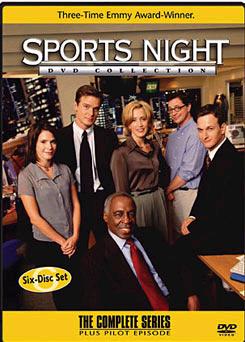
So, I don’t know if it was the beginning of my annual sports addiction or the start of my new Netflix membership (a good deal if you love watching great films and shows, and are cableless and disgusted by TV and Blockbuster), but I have recently become reacquainted with one of the best television shows ever made. My Sports Night revival really began last summer when I was marooned in New Jersey for several weeks without my family. My friend and Rutgers grad student, Ben Johnson, loaned me the DVD box set to keep me company. I recommend it. Rent, buy, or borrow it; but see it soon.
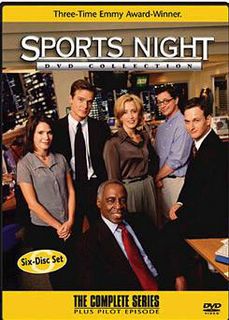


Before Aaron Sorkin’s West Wing, there was Aaron Sorkin’s Sports Night. The show debuted on ABC in 1998 as a “dramedy” about a third-place sports show not unlike ESPN’s SportsCenter.

The multiple Emmy-winner features the on-air stylings of glib co-anchors Dan Rydell (Josh Charles, Dead Poets Society) and Casey McCall (Peter Krause, Six Feet Under) who are supported by their energetic and intelligent producer Dana Whitaker (Felicity Huffman, Desperate Housewives) and quirky associate producers Natalie Hurley (Sabrina Lloyd, Numb3rs) and Jeremy Goodwin (Joshua Malina, West Wing). The cast is held together by CSC executive producer, Isaac Jaffee (Robert Guillaume, Benson and Broadway’s Phantom of the Opera). During the second season, the cast is joined by the enigmatic ratings consultant, Sam Donovan, who is played by the veteran film actor (and Huffman’s husband), William H. Macy.

While much of Sports Night’s success comes from this enormously talented cast; perhaps the real star of the show is Sorkin’s writing. Sure, it took a season or two of West Wing before the general public got hip to Sorkin’s Mamet-esque obsession with rapid-fire dialogue. And, yes, maybe the dialogue can be a little too self-congratulatory in its speedy verbosity. But in a vast primetime wasteland where pratfalls, hijincks, and emotional gimmickry continually pander to the lowest common denominator, the Sports Night banter is sweet relief. The dialogue doesn’t just push plot or reveal character, it sings.

"Any time you write words for performance, they have the exact same properties as music," says Sorkin. "There's rhythm, tone, pitch, volume. You'd be silly to ignore the sound of music."

Witness this exchange between Casey and Dan.

Casey: It's a vicious circle.
Dan: Yep. Just keeps going around and around.
Casey: Never stops.
Dan: That's what makes it vicious.
Casey: And a circle.

Or Natalie and Jeremy dealing with a relationship and a card game:

Natalie: How do you know I don't have a big house?

Jeremy: A FULL house. Dan already folded the six you needed, and I have the other one. You don't have a house of any sort; you don't even have a pup tent. You've got trip sevens, and I have a straight. I want you to trust me right now. I want you to say to yourself, yeah, I've dated a string of jerks in my life, they were stupid, they were mean to me, but maybe this one's different. Maybe I should take a chance and not adopt the break-up-with-him-before-he-breaks-my-heart strategy. I want you to remember that when I started liking you, I didn't stop liking tennis. And I want you to know that I don’t think there's a woman in the world that you need to be threatened by, no matter how glamorous you think she is. But mostly, I want you to trust me, just once, when I tell you, you have three sevens, and I have a straight.

It is just this smart blend of comedy and drama that distinguishes the show as a giant among its contemporaries. With the possible exception of M*A*S*H, there has never been a show that so consistently prompted laughs and tears in a 23-minute time span. Most episodes contain an emotional crescendo that succeeds because Sorkin and the cast make it believable without resorting to manipulation or jokes.

A classic example is found in the pilot episode. Casey is recently divorced and depressed about the world of sports. He is thinking about leaving the show, because he is worried about the influence all the scandals and misbehavior are having on his young son. During the episode the staff decides to do a story about Ntozake Nelson, a 41 year-old South African distance runner, who had been jailed and tortured for years, and was running the 15,000 meters that night in the World Pacific Games. The network objects to them doing a segment on Nelson, but that night they all gather around the TVs in the newsroom watching Nelson win the race and set a new world record. Casey scrambles to a phone near the end of the race and calls his son.

“Son, turn on the TV. Turn on my channel. I want you to watch this guy named Ntozake Nelson run. I’ll tell you more about him later, but for now just watch him run faster than any human being ever has. If your mom will let you, you can stay up and watch the first part of the show when we talk about him. When I give you the signal, you need to turn off the TV and go to bed.” As he speaks, you can’t help but be buoyed by Casey’s reanimation: the belief that there is hope; there is good left in the world.

The show succeeds because it does well with workplace comedy, romance, and intrigue. But the show is great because it reveals grace. It reminds us that relationships are more important than…anything. The characters regularly rally around the one among them who is in need, even if it means sacrificing ratings. Whether it is Isaac’s stroke (Guillaume suffered a stroke in reality) or Natalie’s assault, the show testifies to a system of values that has been obscured by our current lust for profits and celebrity.

This spirit is apropos of the show’s demise. In spite of Sports Night's quality appeal to comic nobility, it was cancelled after a mere two seasons. It could have had something to do with the lame laugh track (that was slowly phased out in the first season). The title could have been off-putting to non-sports fans (even though you don’t need to like or know anything about sports to enjoy the show). But I imagine it was the cognitive dissonance caused by the frenetic dialogue and the difficult-to-categorize nature of the show. The average viewer didn’t know what to do with Sports Night. What is the show? Is it a comedy or a drama? How am I supposed to feel? Tell me what to think. I’m a sheep. Baahhahhahh. Baahhahhahh.

I don’t care to dedicate space and time analyzing the reasons Disney’s ABC made the boneheaded decision to cancel Sports Night. I can only assume it didn’t satisfy the public’s appetite for mind candy.

"It's very difficult to do something new on TV," concedes Sorkin, who acknowledges that "especially with half-hour TV, you need to feel comfortable and familiar." Sports Night, he says, "isn't actually very good background music. You need to give it attention, and maybe people don't feel like doing it."

Even though Sports Night was smart without being inaccessible, funny without being gag-driven and serious without being maudlin, the American public’s short attention span and maddening addiction to consensus narratives doomed the show. Perhaps ABC’s strategy to repeatedly preempt the show for Who Wants to be a Millionaire? and other asinine programming options had something to do with it as well. As a result, we never got the chance to integrate Sports Night into our water cooler discussions or the cast’s pre-show wish and a post-production validation, “Good show” into our lingo.

I suppose the purpose of this post was to lament the loss of a great show. I know it is available on DVD, and until recently, those of you with cable could watch reruns on Comedy Central. It’s not that the show is unavailable; it’s that there won’t be any new episodes. And, I suppose it’s more than that: It’s that we live in a society that has become so addicted to the empty calories of reality shows and Must-See TV, that when they are served something of substance, they choke on it.

Perhaps this post is best ended with a line Casey delivers at the end of a broadcast:

“If you had half as much fun watching this show as we did making it, well, then we had twice as much fun making the show as you did watching it.”

Good show.

Tuesday, March 08, 2005

HELPLESS


So there I was driving to church listening to k.d. lang’s Hymns of the 49th Parallel. When I got to her cover of Neil Young’s “Helpless,” my heart broke. In that moment, Young was the author and lang was the finisher of my faith. I can’t explain it, but I was smitten with a belief that was at once rank and pristine. It was like being lifted on the wings of a pigeon: hopeful and foul.

Baby can you hear me now?
The chains are locked
and tied around my door
Baby, will you sing with me somehow?

Helpless, helpless, helpless
Helpless, helpless

Blue, blue windows behind the stars
Yellow moon on the rise
Big birds flying across the sky
Throwing shadows in our eyes
Leaves us

Helpless…

(“Deja Vu” Crosby, Stills, Nash & Young © 1970 Atlantic Records)

Perhaps it had such an effect on me because I have been a religious vagrant and rambler for 20 years, and I am pretty damn tired of it.

I grew up the son of a Southern Baptist preacher. In 1985, when my parents left the state and I stayed, I found myself at sea without a pastor. For several years my spiritual DNA kept me in the Baptist culture, but I was increasingly drawn to folks who were tired of easy answers and were resisting the rightward shift by becoming subversives or expatriates. I reached a point where I couldn’t take it anymore. Even though there were Baptist people I loved (and still love) like family, the denominational leadership-sponsored violence toward women, the poor, homosexuals, public schools, Democrats, etc. in the name of God just became too much for me. So I split.

For years my family and I shopped around and experimented with different denominations (I won’t bother you with the details of that excruciating journey.). After a while we discovered we had a community of friends and neighbors that felt very much the way we did. We all wanted to be connected to God and other believers in a tangible and important way, but we also wanted to serve the aims of social justice within an urban, historical community of faith. None of us was interested in the pop religion of the Six Flags Over Jesus out on the highway, or the society churches where jackets, ties, and Lexus SUVs were mandatory.

We were not the picture of church perfection (or maybe we were). Our group ranged from agnostics to fundamentalists. Our gatherings were more likely to include pitchers of beer and rowdy debates about the divinity of Jesus than they were to involve polite conversations about Focus on the Family.


So like pigeons, all dirty and hopeful, 20 or 30 of us converged on a dying Methodist church. We had decided Methodism represented the closest thing to Baptist passion without the dogma. This particular church had a new pastor we liked and a great old red brick building in the middle of an urban setting. The existing congregation had dwindled to under a hundred, and consisted largely of elderly people who refused to flee to the ‘burbs like everyone else. They were unbelievably kind and welcoming; but the grip they had on the past was not allowing them to move into the future.

Shortly after our move, our more conservative friends left for a church that was more passionate about the Bible and evangelism. I suppose our more liberal friends slowly quit coming because there wasn’t enough social action and energy. Some quit because change was coming too slowly.

Soon we were left with about four pigeon families from the original flock. We were all vigorously flapping our wings: teaching, singing, cooking, and serving on dozens of committees. The original members of the church continued to be supportive of our presence, and we maintained a certain faith in and passion for change. This too has begun to pass.

Some of our remnant are leaving because they decided to divorce themselves from a United Methodist structural hierarchy they believe to be corrupt and dishonest—consumed with attendance figures and money more than grace and justice. Others are discouraged because they feel like the enormous amount of resources they are committing to fight institutional and spiritual lethargy could be more effectively applied elsewhere.

I’m left helpless. That’s me in the corner, losing my religion.

Why does it have to be so hard? Why have I had to search these last 20 years for a true community of faith, only to be repeatedly disappointed or betrayed? Should I just settle? Should I join the JC Supercenter (credit for that metaphor belongs here) out on the highway and just enjoy the show? Should I let inertia overcome me and quell my irreverent passions? Should I just give up? Does faith require religion? I don’t know anymore.

I believe in a personal God who is in love with me. I believe that God dances at the sound of my name, not because I am worthy or special, but because God is Grace. My desires sound pretty simple: I want to build a fire with that Grace and huddle amidst the storm with a group of fellow refugees. I want to invite the poor and the cold and the lonely into the warmth, even into the fire itself so they are incandescently transformed, not patronized. Is that asking too much? Is it impossible? Appears to be. Believers in and out of the church tend to just huddle, with no fire to warm them and little concern for outsiders.

So maybe I’m just as well off out of church as in it. But Middle Class Tool cautions:

But there's no community in that. There's no communion of souls, no chance to hold hands and sing, to chance to bare ourselves to one another. There's no family, no discussion, nobody to help you along your path. If we have the opportunity, if we have others, shouldn't we come together and eat and sing and read and reflect and discuss and argue and hold each other and laugh and weep, give thanks for our lives and celebrate the one we hold to be responsible for those lives? Shouldn't we pool our resources and use them to help feed the hungry, clothe the naked, and heal the sick? Isn't that also what religion should be about?

Of course, ‘Tool recognizes that all those things can exist outside the organized church. They just don’t usually.

In response to my current angst, a dear friend pointed out to me that my “friend community” was much larger, more diverse, and more vibrant than my organized church community; and that it is full of energy and grace. He pointed out that the Good Samaritan was portrayed as our model of Christ-like behavior, and he was outside the “church.”

He’s right. I have been blessed with a wonderful family and an extraordinary community of friends. I love them with all my heart. I guess I just don’t trust myself. If I have no liturgy or ritual, no official call to prayer and service, will I do it? Probably. But at this moment I can’t be sure.

So, back to my helpless trip to church. I can’t make the move my friends have. At least not today. Maybe I will and together we will defy the religion cartel and create something wonderful and holy together. Or, maybe I’ll be filled with inspiration and the power of 50 men as I reform the church with the jawbone of an ass. Or, maybe I’ll worship at Bedside Baptist Church, slouching downstairs for coffee and pancakes as I sing the Doxology and scratch. I don’t know.

For today, some homing signal still calls me to church. On the way, my prayer will be the one penned by Bruce Cockburn, once again given voice by k.d. lang.

Oh I have been a beggar
And shall be one again
And few the ones with help to lend
Within the world of men

One day I walk in flowers
One day I walk on stones
One day I walk in hours
One day I shall be home

(“One Day I Walk” High Winds White Sky © 1971 Philo Records/Rounder Records)

Sunday, March 06, 2005

LIFE AFTER ALL

About two and a half years ago, my friend Todd Mincks and I started writing and performing music as the acoustic duo "Brother Wiley." It was just two guys, two guitars, three chords (quite literally), and the truth (sorta). With the friendly help of Beth and Mike at Well Fed Head Books, and proprietors of a few other local establishments, we started playing for whoever would listen. Some people said they liked our music. And they weren't even drunk. A few months later we made a homemade recording of our songs. It was pretty good for a 24-hour recording session on cheap, crude software; but as the songs evolved and we wrote new stuff, Todd and I developed the urge to create something more substantial.

Some months ago we started working on a studio CD tentatively entitled, "Life After All." Performing now as "Mincks and Miller" (We got tired of explaining the name--it had something to do with a road trip to Colorado, a trucker, and Jesus--and having people named Wiley asking us if we were kin.), we enlisted the recording help of our good friend, Mark Bilyeu. As a singer-songwriter, guitarist, producer, and indie record company executive, Mark has few equals. Best known for his work with Big Smith, Mark's soon-to-be-released self-produced solo CD is going to blow people away. So, we're in good hands.

Since we probably won't finish the album until late spring/early summer, I thought I would occasionally fill you in on our progress.


Dog is his co-pilot: JB 

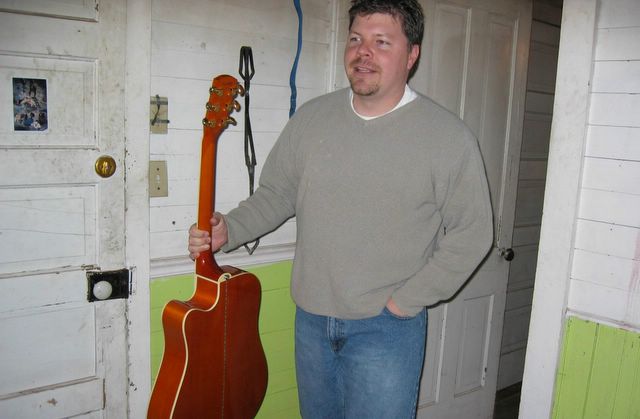
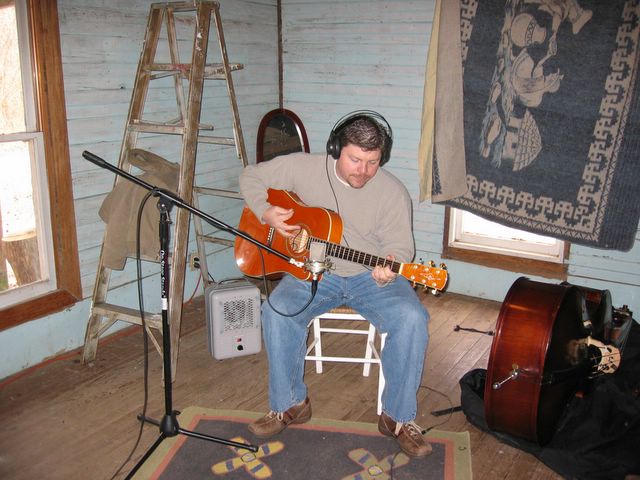
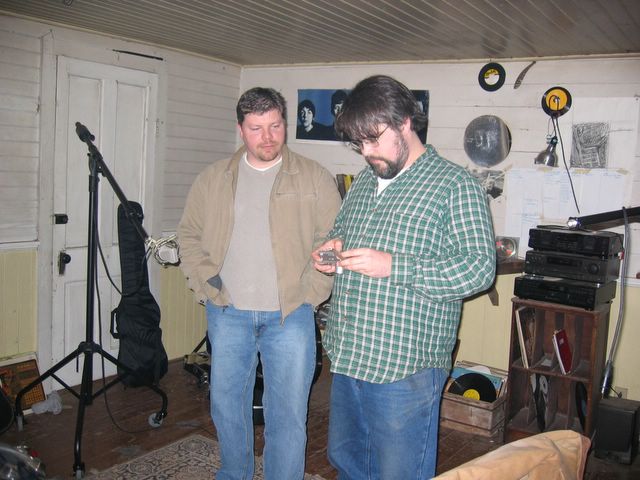
After laying down the percussion tracks with drummer, Kenny Wirt, we gathered in the woods a few weeks ago for some bass and acoustic guitar work. Mark and Jonathan Bentley had just finished a marathon session for JB's new disc (watch for it), and Jonathan was kind enough to allow us to use his cabin.

I didn't have much to do that day, since my contribution as an instrumentalist is an occasional splinky-splink on the rhythm guitar and the mournful train whistle, so I took some photos.


Todd's Elvis entrance: I'd like to thank each and every one of you. Thank you. Thank you. Thank you...


King Midas at work: Mark Bilyeu 


I sound just like Jackson Browne...I'm serious 


What's it? Who's it? Aren't we? 


My Wingman 


Bass-slappin' Liz 

MayApple Records exec and Mark's bride-to-be, Liz Lairmore, came by to see her honey. Liz is becoming quite the upright bass player (I mean, the bass is upright. I guess Liz is upright too...in a scoundrely sorta way.); and while she was there, Todd showed her a few licks on the bass geetar.

Things are going well. The album will probably end up with 12 tracks (we figure, 12 disciples, 12 steps...huh? huh?). A few of them will be new versions of songs on the original Bro. Wiley disc. We are pleased with the content of the songs, and Mark is making us sound so good, our mommas will cry. We're expecting several other talented friends to sit in over the next several weeks, and make the sound even better.

Stay tuned for updates. When we finish some tracks, we'll make them available for online listening.

Saturday, February 26, 2005

IN A MANURE OF SPEAKING, VOL. II

…and we’re back.

When we left Dr. Frankfurt he was telling us that bullshitting is pervasive and that it performs differently than lying because it shows no regard for truth or authenticity. We also heard him argue that bullshit has a corrosive effect on our culture; consequently, we should try to understand it and address it. I’m the choir, and he’s preaching to me on that score. The culture of cynicism and nihilism fostered by the ubiquity of bullshit should alarm and provoke us.

As we rejoin the good doctor, however, I must take up the cudgel. Don’t worry, it’s a small cudgel; I’ll only give him a spanking.

Frankfurt says, “I shall not consider the rhetorical uses and misuses of bullshit.” By claiming that we can misuse bullshit, he accepts that it could be used appropriately; but we don’t know how or under what conditions. He acknowledges that there may be something important or useful about bullshit, then exempts himself from the argument by refusing to address it. The problem is that he goes on to categorically reject the validity of bullshit.

He stakes out his philosophical ground when he says,

The contemporary proliferation of bullshit also has deeper sources, in various forms of skepticism which deny that we can have any reliable access to an objective reality and which therefore reject the possibility of knowing how things truly are. These “anti-realist” doctrines undermine confidence in the value of disinterested efforts to determine what is true and what is false, and even in the intelligibility of the notion of objective inquiry.

Frankfurt is taking Plato’s side in the age-old quarrel between philosophy and what he sees as the skepticism of rhetoric. Skeptics like Gorgias and Protagoras—Plato’s contemporaries—rejected the idea of a reality that could be known or communicated without distortion. Consequently, they embraced the practice of rhetoric known as “sophistry.” In short, sophists believed that since there was no truth to be known, you were better served to learn the skills of persuasion than philosophy. Plato claimed that this practice of rhetoric was “an art akin to cookery;” he argued that people should concern themselves with the truth of philosophy, rather than the “deceit” and “trickery” of rhetoric, where “the lesser is made to appear the greater.” (Of course, in order to make his case Plato had to make use of…er…rhetoric.)

Enter Plato’s student, Aristotle. Much like his mentor, Aristotle believed in truth and the virtues of philosophy, but he also recognized the value of rhetoric, defining it as “the faculty of discovering, in any given case, the available means of persuasion.” Aristotle argued that since most of the public situations we face are contingent issues (like whether there were WMDs in Iraq…wait…bad example), where the truth does not naturally win out; we need to use rhetoric to construct and communicate truth. He also maintained that there was more to persuasion than Platonic reason; appealing to emotion and credibility were equally important to Aristotle’s view of rhetoric.

Frankfurt seems to believe that all rhetoric is sophistry, and suggests that anything short of truth is bullshit, no matter how sincere.

One response to this loss of confidence has been a retreat from the discipline required by dedication to the ideal of correctness to a quite different sort of discipline, which is imposed by pursuit of an alternative ideal of sincerity. Rather than seeking primarily to arrive at accurate representations of a common world, the individual turns toward trying to provide honest representations of himself. Convinced that reality has no inherent nature, which he might hope to identify as the truth about things, he devotes himself to being true to his own nature.

He goes on later to rather succinctly state that “sincerity itself is bullshit.” So to him, it’s an either/or proposition: you’re either dedicated to the correct understanding of truth, or you abandon the truth for a form of narcissistic deception.

Just as hot air is speech that has been emptied of all informative content, so excrement is matter from which everything nutritive has been removed. Excrement may be regarded as the corpse of nourishment, what remains when the vital elements in food have been exhausted. In this respect, excrement is a representation of death which we ourselves produce and which, indeed, we cannot help producing in the very process of maintaining our lives. Perhaps it is for making death so intimate that we find excrement so repulsive. In any event, it cannot serve the purposes of sustenance, any more than hot air can serve those of communication.

It’s a potent metaphor and an admirable sentiment. Poop isn’t useful. It contaminates our lives if we don’t deal with it (and it backs up on you if you eat too much cheese). Unfortunately, there is a big difference between our body’s ability to separate nutrients from toxins and the human mind’s ability to separate truth from trickery. What is “hot air?” How do you mark the difference between bullshit and truth? Is there no middle way between those who profess access to truth and those who abandon truth for complete skepticism? Is communication bullshit if it does not serve as an unmitigated conduit between truth and audience? There’s also this: bullshit is used as fertilizer, right? Not to create a metaphor carnival here, but isn’t it possible that some bullshit aids in the growth of new ideas? If I am expected to get it right every time, meeting the “ideal of correctness,” isn’t the likely outcome that I will be consumed by anxiety and stop communicating much at all?

I have faith that truth is “out there;” but I recognize the futility in articulating it with complete correctness. The moment you lay your hands on an idea and begin to translate it into your language, it changes from what it is in reality to what you interpret it to be, unless of course your interpretive insight is infallible or you have gotten your hands on the Handy Dandy Double Dog Universal Decoder Ring (and don’t tell me the answer is the Bible, what with its multiple interpretations and the fact that it doesn’t tell us how to vote or whether Thursday night on NBC is truly “Must-See TV”). All we get are partisan glimpses of the truth as it passes by. Does that mean we have to become skeptics and traffic exclusively in bullshit? Frankfurt leaves us with only two options: get it right or sling shit.

It seems to me that there is a role for meaningful communication that isn’t rooted in certainty or skepticism. I think we can ditch this obsession for truth without abandoning it altogether. I propose a relational rhetoric: a form of communication where neither truth nor man is the measure of all things; relationship is. In relational rhetoric our attention is given to whether we are cultivating meaningful connections with other people. In this equation, a compulsive concern for truth is wrong because it alienates those who are less concerned, or who share a competing view of truth; and a skeptical rejection of truth is also wrong because it elevates the individual at the expense of others.

In relational rhetoric, untrue claims are okay if they are offered with the sincere intention of moving the conversation forward. If I argue something I’m unsure of, my hope is that I will provoke you to add to the argument or dialogue, making our understanding more complete and our relationship more meaningful. As our ideas converge on “truth,” the real truth emerges in and is defined as the relationship we are sharing.

So I agree with Dr. Frankfurt about the culture of bullshit. It contributes to the empty idol of celebrity and the crass egocentricism of the marketplace. But the answer is not to oppose bullshit because it vandalizes truth, we should oppose it when it harms relationships.

This idea needs a lot of fleshing out—some reaching. But before I go on, I want to know what you think.

Reach.

Thursday, February 17, 2005

IN A MANURE OF SPEAKING, VOL. I


Princeton, NJ: Princeton University Press, 2005

Have you ever wanted to hear a retired Princeton professor talk shit? Of course you have. Then you should listen to emeritus philosophy prof, Harry Frankfurt, offer a treatment of this heretofore unmentionable topic.
One of the most salient features of our culture is that there is so much bullshit. Everyone knows this. Each of us contributes his share. But we tend to take the situation for granted. Most people are rather confident of their ability to recognize bullshit and to avoid being taken in by it. So the phenomenon has not aroused much deliberate concern, or attracted much sustained inquiry. In consequence, we have no clear understanding of what bullshit is, why there is so much of it, or what functions it serves. And we lack a conscientiously developed appreciation of what it means to us. In other words, we have no theory.

This is a topic that is near and dear to my heart, and—if my wife is to be believed—sometimes near to my mouth. I absolutely despise bullshit, yet I possess a natural capacity for producing it. When one of my favorite musicians and scholar-poets (who also shares a similar bullshit aversion/production paradox) alerted me to a NY Times article about Frankfurt, I first thought it was a bunch of BS. And I was right.

I confess I haven’t yet read the book, but I have read the original essay from 1986. Since the book is less than 80 pages long, I suspect I have bitten into the meat of it. (If you don’t have the patience or Ritalin to make it through the text, here’s a video interview with the author.)

While he fails to develop a “theory” of bullshit, Frankfurt successfully engages the fact that the ubiquity of bullshit has dulled our regard for truth; and no one seems terribly concerned about it.
It is just this lack of connection to a concern with truth—this indifference to how things really are—that I regard as of the essence of bullshit.

In an effort to define it, he points out that bullshit doesn’t perform exactly the same as Max Black’s concept of “humbug,” (“balderdash,” “claptrap,” “hokum,” “drivel,” “buncombe,” “imposture,” “quackery”). Frankfurt goes on to draw a clear distinction between lies and bullshit. Liars are arguably less reprehensible than bullshitters, because liars respect (somewhat) the truth by acknowledging it as they seek to obscure or deny it. Bullshitters have no regard for the truth whatsoever.
It is impossible for someone to lie unless he thinks he knows the truth. Producing bullshit requires no such conviction. A person who lies is thereby responding to the truth, and he is to that extent respectful of it….By virtue of this, bullshit is a greater enemy of the truth than lies are.


Professor of Poop: Harry G. Frankfurt
For the essence of bullshit is not that it is false but that it is phony. In order to appreciate this distinction, one must recognize that a fake or a phony need not be in any respect (apart from authenticity itself) inferior to the real thing. What is not genuine need not also be defective in some other way. It may be, after all, an exact copy. What is wrong with a counterfeit is not what it is like, but how it was made. This points to a similar and fundamental aspect of the essential nature of bullshit: although it is produced without concern with the truth, it need not be false. The bullshitter is faking things. But this does not mean that he necessarily gets them wrong.

When Ashlee Simpson lip-syncs on Saturday Night Live, she doesn’t necessarily sound bad (unless, of course, you despise bubble-gum-pop-slop to begin with), she just isn’t real. When Disney builds a brave new town in Florida called Celebration, the historical feel of urban community isn’t wrong; it’s just creepy because it’s engineered. When a finely coiffed televangelist asks little old ladies for their life savings, he….okay, wait…that is bad.

The lack of authenticity promoted by the entertainment, cosmetic surgery, political, and religion industries (to name a few) inflict a certain kind of violence on the truth. We are conditioned to evaluate product, with no concern for process. As long as Oz functions, nobody cares about the man behind the curtain.

I don’t care how she sings/she got those boobs/we got into that war/we get them into church as long as she sounds good/she looks good/we win/they believe.

The corrosive effects of bullshit in our society have caused many of us to become cynical, to the point of embracing a dangerous narcissism. All that matters is what we get, not how we get it.

This cynicism plays out in a variety of ways.

The pastor becomes cynical about authenticity, so she fixates on numbers and money as the sine qua non of spiritual success. The postmodern wanderer becomes cynical about authenticity, so he gives up on organized religion altogether.

Arguably, our fight is not against flesh and blood, it’s against the bullshit that vandalizes the truth and separates us from authentic relationships.

Coming Soon—IN A MANURE OF SPEAKING, VOL. II
I will connect bullshit theory and communication, and I will be taking Dr. Frankfurt to task for his views on “truth” and the impact his thoughts have on argument and rhetoric.

Thursday, February 10, 2005

SNOW DAY GRACE


How do you define grace?

The Sunday School Answer: “God’s love for us.”

The Bible College Answer: Some cute acronym like “God’s Redemptive Atonement through Christ for Everyone.”

The Seminary Answer: A completely uninspiring discussion of five-point Calvinism, or some competing theological matrix designed to fully convey the intersecting nature of sovereignty and redemption. Yippee.

People who are lacking in one of these programmed responses—once they understand you are talking about the faith issue and not the grace of gazelles or figure skaters—will usually get a little dreamy-eyed, then stumble around trying to put words to their yearnings. I understand that feeling: beggared speech in the presence of my heart’s desire.

I have never been fond of rational explanations for something that is such a familiar mystery. I used to define grace as a hot cup of coffee on a rainy day; but something happened a few years ago that changed my metaphor. It was during the winter of ‘99 that I decided grace was a snow day.

I had spent ten years as a high school debate coach, my wife was a first grade teacher, and our girls were in elementary school. So when we heard a snow day cancellation on the news, it was like we were all axe murderers who had just gotten a stay from the governor. Ahh. Life.

If you live too far south you don’t understand the pure joy that comes when you sit up in bed, listening to the radio as the announcer makes his way through the alphabet.

The A schools…the B schools….(They had only forecast 2-3 inches the night before, which might not be enough to call off school; but it was still coming down.) Wait…wait…the K schools…the L schools….Commercial….Seven minutes of commercials! I really needed to pee, but I was afraid I’d miss it. Picking up with the M schools…wait…wait…here we go…THERE IT IS! The 2-3 inches was going to become 14 INCHES by the end of the day! This was going to be a snow week!

The house erupted with cheers, dances, and a flurry of activity in preparation for snow and snow-related fun (we love snow, mmmmm…snow). I walked past my oldest daughter’s room and my attitude soured. The room was a mess. She was supposed to have cleaned it yesterday.

“Cassidy.”

“Yeah,” she replied, while furiously tugging on her boots.

“Did you clean your room last night like I asked?”

Boot-tugging ceased. One on, one off.

A weak “no.”

“No snow for you until this room is completely cleaned up.”

You would have thought that I just told her I killed baby monkeys for a living. It wasn’t just a protest; it was the deepest heart-wrenching form of pain. She looked at me with those I-can’t-believe-you’re-a-monkey-killer eyes, and tears began to spill.

But I was going to hold firm, by God. (What a great piece of leverage, the snow. You don’t pay, you don’t play.) I had her and she knew it. She lodged her feeble complaints, but she knew she had no grounds. She also knew that her room was not going to be cleaned quickly. It was bad.

She turned and limped down the hall, mono-booted and fully resigned to her situation. As I watched her make her walk of despair and heard the sobs beginning, my mind turned to grace for some strange reason.

I had heard about grace all my life; it was a familiar term. But I had recently become attracted to the radical teachings of people like Henri Nouwen, Philip Yancey, and Brennan Manning, who describes grace as a “relentless tenderness” that is unmerited and transforms the way we inhabit the world. This new grace does more than provide cheap comfort and make us feel good, it causes us to adopt a posture of gratitude rather than fear. Becoming an agent of grace means having the faith to trust.

What a hypocrite you are. You talk about the way this irrational, radical grace can transform relationships, even whole cultures, but every chance you get you make sure that everybody gets what they deserve. That’s right. Serve up justice, baby. Make’em pay. Don’t let anyone get by with anything. Give them an inch and they’ll take a mile. If you don’t hold this girl accountable, there’s no telling what she’ll do next. Little sinner girl.

Stop.

Deep breath.

“Cassidy,” I said. “Go ahead and get your clothes on and go outside.”

“I can’t,” she replied with small shoulders hunching up and down and sob spasms pulling her chin in and out of her chest. “I (sniff) Have (hic) To (hic) Clean (snort) My (snort) Room (rapid F-sound inhale…head rises…then long exhale) Firrrrrrrrrrrst (head sinks).”

“You’re right; your room needs to be cleaned. But you go on out. I’m going to clean your room for you.”

The look will never leave my memory. It burned into me the way only the deepest delight and hardest pain can. The astonishment: Who are you and what have you done with my father? The ecstasy: Snowww Funnnn! It thrilled me that an act of grace had the power to elicit such a response. But it broke my heart that when my little girl looked at me she expected justice, not mercy.

She spent the morning dodging snowballs, making angels, and chasing down jewelry and clothing for the snowpeople slowing populating our yard. I spent the morning digging through layer upon layer of mess.

There were no thanks when she came in for the day. I expected as much. I reminded myself that this life of grace was going to be difficult. Some wouldn’t appreciate it. Some would resent it.

That evening Cassidy came to me with a wad of money in her hand.

“What’s this, honey?”

“It’s what’s left over from my allowance. I’m giving it back because I didn’t clean my room. I’m sorry. Thanks Dad.” She hugged me and ran off to get her hot chocolate.

Everything changed for me right then. In that moment of faith and glory, grace went from being a cute, domesticated religious idea to being my only source of hope. It became the single most important thing in the world to me. Without you, grace, I will surely fail. I will become the worst kind of angry, self-righteous Pharisee. I could do well in this life, I could even prosper; but without grace, it all collapses in on itself.

Justice and righteousness give us certainty and order. But grace gives us freedom and life.

I would like to report that my life has become much more grace-filled, but I’m not sure I can. My daughters still look at me with astonishment on the rare occasion that I show them gratuitous mercy and tenderness. I still don’t trust as much as I should.

I have not arrived, but I still reach.

Maybe it will snow tonight.

Friday, February 04, 2005

THE FIRST RULE OF FREE SPEECH: THERE IS NO FREE SPEECH


I teach at a relatively conservative evangelical Christian university. While the campus environment causes me frustration at times, I stick around because I like the students and the schedule allows me time to do things like write, play music, and be fully present as a father and husband. Despite the aggravations of denominational power plays and the latent hostility toward progressive ideologies, I enjoy the fact that, as a communication professor, I get to regularly challenge common assumptions and provoke my students to new awareness. Some of the students respond well to the challenge, and the administration has been (so far) supportive of my academic autonomy. On the whole, it's not a bad life.

But something happened yesterday that has shaken my commitment. Did the university endorse James Dobson’s latest proclamation that houses painted in SpongeBob SquarePants color schemes are dens of homosexuality? No. Did the Big Denomination declare that church-sponsored schools much teach that Arabs evolved from mongrel bacteria, separate from God's creation story in Genesis, and thus undeserving of human rights? No.

I was violated. My property was stolen and vandalized. Someone ripped a bumper sticker off my car.

Since September of last year, I had been sporting this sticker produced by the good folks at Sojourners.


(For more on the story behind the sticker, go to Sojourners, or The Ready Room.)

It was my small way of speaking out against the swelling red tide as my state shifted from light blue, to ever-deepening shades of pink. In particular, it was my challenge to those around me who have come to believe that there are three important issues in public life and that the Republicans, the church, and God are all in one accord.

Shortly after the election, when so many public figures were doing victory dances and declaring that The Truth had triumphed and that the election was a referendum on God’s will in public life, I altered the sticker to look like this:


After all, the Democrats weren’t claiming to own God like some of their counterparts. The first version of the sticker seemed appropriate as a pre-election cautionary remark, but the post-election arrogance and talk of “mandates” changed my sticker rhetoric into an act of public dissent.

Well, apparently someone decided yesterday that, in fact, God IS a Republican. Furthermore, they decided that I should be denied the right to declare otherwise. It angered and saddened me. Why did it bother me so much? I mean, during the election season we had about 10 campaign signs stolen from our yard. Sure those thefts bothered me, but not like this. My house isn’t on a university campus where free inquiry and speech are supposed to be celebrated. And the sign thieves weren’t necessarily part of a faith community that professes to have a high regard for morality.

I thought about what had provoked such a vile act. I mean, the sticker had traveled on and off campus, unmolested for months. Why now? Then I discovered something that made it clearer.

Scholars at the University of Connecticut recently completed an incredibly comprehensive study in which they evaluated the attitudes and knowledge of the First Amendment among 110,000 high school students, faculty, and administrators. The results are disturbing…shocking even.

Since the attacks of September 11th a sizeable portion of our students and leaders view the First Amendment with apathy, even a certain degree of disdain.

73% of the students have no opinion about the First Amendment, or they take it for granted.

21% do not know enough to express an opinion, even after the Amendment is read to them.

44% with an opinion think that the Amendment goes too far, granting too many freedoms.

Nearly 30% of faculty members feel like the Amendment goes too far.

75% of students think flag burning is illegal.

Nearly 50% assume the government has the right to censor material on the Internet.

17% believe people should not be allowed to voice unpopular opinions.

49% think the news media should receive governmental approval before publishing stories.

20% of faculty agree that media should seek governmental approval
.


And at least one member of my university community believes it is justified to liberate the rear-end of cars bearing unpopular opinions. Why is all this happening?

The experts agree that our educational system is failing to promote knowledge and interest in basic democratic freedoms. “Schools don't do enough to teach the First Amendment. Students often don't know the rights it protects,” says Linda Puntney, Director of the Journalism Education Association.

Marilyn Weaver, journalism professor at Ball State University, finds that “students are really not very informed.” She goes on to state that “Schools don’t encourage and nurture free thinking and free expression.”

According to journalist Sandy Woodcock, “The First Amendment is…like the granite monument in the park that we never visit.”

There is no question that our schools (and universities) have failed in their responsibilities. But I think it runs deeper than that. Our government, media, and churches share in the shame.

Here are just a few of the examples:

We have a president who aggressively quashed dissent during his campaign, by excluding political outsiders and establishing “protest zones” to safely quarantine disagreement.

We have a Justice Department that regularly elevates security over freedom, even condoning torture of our enemies.

We have an Executive Cabinet where those of different opinions are removed and those who remain operate as little more than an echo chamber for puppet masters.

Journalists accept money from the administration to promote policies under the guise of objectivity.

Our mainstream and conservative media inflict subtle (and not so subtle) shades of violence on those who report anything deemed “unpatriotic.”

Many churches and faith-based organizations make it very clear that there is one God (theirs), one Truth (again, theirs), and one ideology (you guessed it). Disagreement could endanger your mortal soul
.

(Sure, I am mindful of the misrepresentations and fear-mongering among the Left. It’s there and it’s reprehensible. The difference is few of them do so in the name of the Lord.)

When young people see the culture around them placing an ever-increasing set of limitations on freedom, they begin to believe that what they think is true should have no competition. After all, they are right, and what is wrong is evil. Their culture has told them that evil should be destroyed.

To the person who stole my sticker I say, “Read more. Pray more. Think more.” Oh, and buy me a new sticker, dammit.

To all who regularly passed by my sticker, hating what it stood for, even talking bad about me, but leaving it alone, I say, “Good for you. Thanks for having an opinion and freely sharing it. And thanks for allowing me to do the same.”

Now, I have to go buy some paint. What were those SpongeBob colors again?

Sunday, January 30, 2005

A WRITTEN CONTRADICTION

From time to time I will post pieces that might best be desribed as story-essays. Maybe I’ll call them stessays, or essories… or fictessays…fictessories…essayictional. Perhaps real writers have more elegant names for such things. Some columnists do it and call it journalism. Some CEOs do it and call it creative accounting. Some politicians have done it and called it justification for war. Preachers do it all the time in the name of the Lord. I just do it to tell a truth. I’m not pretending to report the news to you, or ask you for your vote, or convert you. If I were, I would have a strong responsibility to be as accurate as possble. But in this web log, I’m just telling you things that are meaningful to me, in a way that is meaningful to me. Hopefully you will find them meaningful as well. I leave it to you to pull the truth from the tangles.

These writings generally begin with and follow the details of real-life events. The mountaintop story pretty much happened that way, at least as it lives in my memory. The Chicago El story is accurate too, except that at the time I had no vision of God as an Asian woman, and I couldn’t possibly have gotten all the dialogue correct. And I don’t think the Fullerton stop is on the Red Line. That’s the way it works. I mean, when Frank McCourt tells us in Angela’s Ashes about a conversation he overheard when he was six, I don’t believe for a second that it actually went down that way. Doesn’t mean the story isn’t true.

The truth isn’t always in the data. More often than not, the truth is in the telling.

I’m not attempting to fictionalize the events to deceive or manipulate. I’m not selling anything. It’s just that as I recall these things I can’t always remember all the details, so I fill in the blanks. Also, I think about the meaning of the events. What the story means is as real as what physically happened. If I want to dramatize that meaning, I can. It’s my blog and I’ll do what I want. If you don’t like it, argue with me in the comments section, or add me to your prayer list, but for God’s sake don’t talk to me about the Truth unless I'm your president or pastor.

I happen to believe that there is a Truth “out there,” separate from our experiences. But I also happen to believe that such a Truth is pretty worthless. The only truth that matters is the one that’s “in here,” emerging through our stories and our relationships. Anything else is just a weapon. If it has to start with a capital letter, it’s probably used way too often to inflict blunt trauma.

If you’re the type to get your panties in a twist over what’s “true” and what’s not, here’s my advice: relax your grip on all the things you think you possess. First because it’s pure folly to think you really own anything anyway. And second, just because you think you control it doesn’t make it yours. Just sit back and enjoy the reach.

I heard singer-songwriter David Wilcox talk about putting God in a box, and how absurd that was.

“That’s like trying to put the wind in a box. You open the box a few days later, and you go ‘Damn, he was just here’.”

Kris Kristofferson might say these stories I share are a written contradiction: partly truth, partly fiction. Me? I’d say if Kris Kristofferson said that, he’d be mostly right.


COMING IN FEBRUARY: Book Reviews and…Politics (I think I’m finally ready to talk about it again.)