I have been away, mentally and physically, for the past couple of days. I may try to unravel the incredibly tangled web we created with that last post. I just don't have the energy or desire at the moment.
I spent this afternoon with her and her family.
I sat in the courtroom, at the county courthouse, in my college town, watching a preliminary hearing. My presence was motivated by nothing but her desire to be surrounded by people who cared about her.
What a weekend. She graduated on Friday, and this on Monday.
She sat up there on the witness stand, still in her neck collar, and was the bravest person I've ever met. She told all the awful details to the judge, the attorneys, a room full of people, and the accused. She never faltered, never wavered. When she pointed at him, in his orange jump suit, she looked at him for a moment, then she was done. He would maintain no hold on her today.
She made it look easy, even though I'm sure it was excruciating. I know I hurt. I know I couldn't stop thinking about my daughters, until I had to force myself to stop thinking about them so I wouldn't start weeping or cursing. But something about her courage and strength rebuked me. In a strange way, I felt like she was supporting me. Her faith and her bravery surpass anything I've seen lately. I lost the urge to romanticize my pain as a father. She revoked my permission to grieve as a dad. I had no right. We didn't dwell on destruction, we moved on to live and love another day.
When she was talking with her counselor at home, she said, "I'm glad it was me."
What?
"There are a lot of women who wouldn't have been able to handle this. I can. I'm glad it was me and not one of them."
That's one of the most disturbing and beautiful things I've ever heard.
Monday, August 01, 2005


Wednesday, July 27, 2005
GOD HATES FLAGS
Flags have been on my mind lately.
What an interesting thing, a flag. What’s it for? Vexillologists tell us that flags were originally designed for identification and signaling purposes. They were meant to communicate important information in an efficient manner. Most flags have evolved past that, to become largely ceremonial or symbolic. But, events often conspire to reinvigorate flags with new potency.
The tragedies of 9/11 prompted a renewal of the
That’s not what’s on my mind.
The U.S. House recently passed a resolution in June, supporting a Constitutional amendment that would ban flag desecration. It will likely move to a vote in the Senate any day now. Having failed to get the necessary votes the last five or six times it’s been tried, legislators apparently stand a much better chance of passing it this time around. While there are some compelling issues surrounding the issue of flag desecration, that’s not what’s on my mind.
The confederate flag has also received a great deal of attention lately. Several Southern states and numerous local institutions continue to debate the balance between heritage and offensiveness.
But, that’s not what’s on my mind.
THIS is what’s on my mind:
The

I first heard about this flag here and here.
Some of you may be familiar with the original Christian flag, designed by a Sunday school superintendent and a Methodist minister in 1907.
The original pledge to the Christian flag was,

I pledge allegiance to the Christian Flag and to the Savior for whose kingdom it stands. One brotherhood, uniting all mankind, in service and love.
Most conservative Protestant churches, feeling that the message was too broad and liberal, modified the pledge to read,
I pledge allegiance to the Christian flag, and to the Savior for whose kingdom it stands; one Savior, crucified, risen, and coming again with life and liberty to all who believe.
While more than a little disturbing in its crusade-ishness, for decades the Christian flag sat stoically next to the American flag in Protestant churches, proclaiming a strange and benign version of patriotism and faith. It received little attention beyond mumbled rituals of punch-stained preschoolers at vacation bible school.
Well, apparently, the Christian flag’s design and pledge were too anemic and inclusive for Marcia Thompson Eldreth and her pastor.
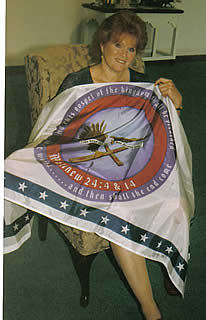
The Betsy Ross of American Fundamentalism designed the new U.S Christian flag, which carries this pledge:
I pledge allegiance, to the Christian Flag, of the United States of America, and to the Lord, who made us great and free. I purpose, to band together, with all believers, to protect the truth and liberty of God.
Holy. Shit.
Where to begin. Why a flag? Why an exclusively U.S. flag? Is the U.S. unique in its "greatness" and "freedom?" When we "band together," is that a thinly-veiled call to arms? By "all believers," does that imply only American believers? Since when did God's truth or liberty need your protection? And that's just for starters.
I know this represents a perverted extreme of the American Christian Right, and I know that many of my conservative friends will recoil at this too; but where is this God-is-on-our-side stuff going to end? Star-spangled bibles? Pistol-packing missionaries? Seeing the cross by the rockets red glare?
Whenever we fly something, wave something, or display something designed to signal our cultural location, our religious identity, or our ideology; and whenever the flying, waving, and displaying become more important than the living and the loving, we have completely missed the point.
My neighbor, Bill, regularly displays an American flag on his house. While Bill and I do not agree about most things political, and I am not much for flag-waving, his flag is not offensive to me at all. Bill is a good guy whose son is in the military, and who is simply proud of his country. He doesn’t fly his flag to say something about me, or to draw some line of division between us, and he would never let his flag come between our relationship as neighbors.
The U.S. Christian flag bothers me a lot. My God and my faith are not things to be possessed by an exclusive group or nation, or weapons to be wielded in a nationalistic culture war.
Jesus said that his followers will be known for their love, joy, peace, kindness, etc. He didn’t say, “They will know you by your flags.” Someone needs to remind Marcia that Jesus taught that we win by losing.
So, does God hate flags? I don’t know. I honestly don’t think God gives a damn about our flags. But I feel sure that God hates it when we spend more time and attention on banners, edifices, proclamations, and policies than we do loving God and loving our neighbors.
Monday, July 25, 2005
ON THE MEND
This is the latest in the story. My sister and brother-in-law just returned to Texas after the VA docs in Madison , Wisconsin
Rick wanted to pass this on to all of you--
To the faithful readers of The Reach, from Reacher's bro-in-law: I simply must say that I appreciate being in your prayers while I was going through the whole head surgery thing. I kept a journal, as is my habit, while all this stuff was happening; but there was nothing I wrote that seemed exceptional, or that I would grasp better at a later time.
What I would like to say is that I am a disabled vet who was in on the end of the Vietnam War. I zigged when I should of zagged, going through a hatch. I got injured, started having seizures, and was discharged. My intention was to join the Navy out of high school, stay 20 years and retire at 37 with a pension. But things don't always go the way a guy plans or expects.
Such is life.
In a way things did go the way I planned....It has been 29 years since my injury. Each month I get a disability compensation check. I feel I should send every taxpayer in
Here's the update: I returned home yesterday. I have been seizure-free since the surgery, and when I have been so for a year I will be eligible for a driver's license. Being unable to drive is the most exasperating aspect of having seizures - and the most inconvenient. Fortunately, my wife and family hang in there. My self-esteem would not break any records, because I feel I have fallen short of any meaningful contribution due to the limits thrust on me. However, because of everybody's prayerful support I now see that things might quickly change. I appreciate y'all's prayers. Thank you. It is my belief that without them there is no hope.
I thank God for my Wonder Woman wife who has been by me the whole time. I believe that without her I would have soon become unfit to live with. And while I would not wish anybody to be injured I can only say head injuries are a strange, intense, and peculiar way to go from day to day. And this is especially true for the caregiver! It takes a special person to provide direct care to someone with a traumatic head injury. Thank you, Sister, for your aid and support. You are my superhero and I can't imagine a pedestal tall enough for you. Nor can I picture me without you.
Reacher Readers: I have been seizure free now since June 15th or so.
Reacher: Thanks for being in
We're all glad to hear it, Rick. It sure is nice to know you'll be with us a while longer. Here's to your health, and may you refuse to give up the fedora, even after the ugly scar heals.
And let me say this about my big sister. Rick's right, she is a superhero. But, her heroics don't come without a cost. She does the heavy lifting like a caped crusader, and she walks through fire for those she loves; but she gets tired and burned, and most of us don't see it. May you heal as well, Sis. And may you rest.
Monday, July 18, 2005
MORE "LIFE AFTER ALL"
For those of you who have paid attention to the recording project, you might be interested to know that all the thumpin', strummin', stringin', singin', hummin', and rat-a-tat-tattin' is finished. For those of you who have not paid attention to such matters - my wife is a covert operative for the CIA. Now, for God's sake, don't tell anybody.
As for the album, we have entered the mixing stage. This is the period where MayApple maestro Mark Bilyeu performs, what Bill Thomas calls, digital witchcraft. He will take all of our raw ingredients and mismatched tomsongery, mix it with an eye of newt, and boil it in his cauldron. When it's done, beasts will be beautiful, frogs will beg for kisses, Howard Dean will know the difference between the Old and New Testaments, and Karl Rove won't be a meany head. He ain't no Gandalf, but what Mark does for guys like Todd and me is the equivalent of turning Rowling into Tolkien. No, wait, that's not right. It's like turning a sad little writing-in-his-pajamas fantasy blogger into The Lord of the Rings.
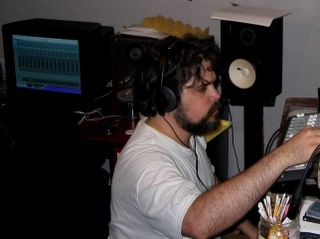
Mark, practicing his dark art.
Actually, magic had some help in this project. We have been incredibly blessed to be joined by some phenomenally talented people. Here they are...

We're thinking about using this photo for the CD cover. It is by Julie Blackmon She is a good friend, and an absolute pro at what she does.
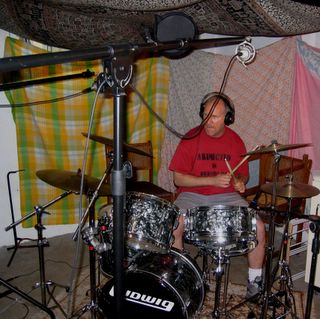
Kenny Wirt played all the drum tracks. He plays with...everybody. He's a rock.
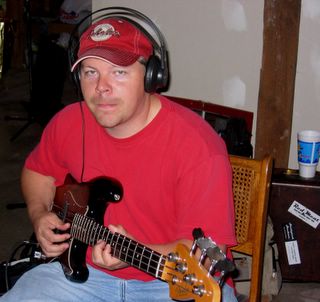
Todd laid down most of the bass tracks. This photo is a reminder that you should never operate heavy machinery while playing funky bass lines.
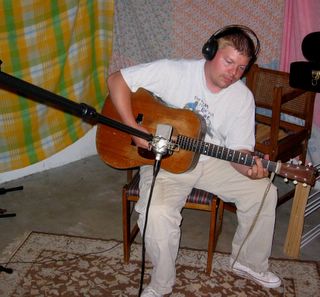
More dreamy flushed looks for Todd? It's the intoxication of playing Mark's '46 Martin.

Along with his mandolin licks, Jody Bilyeu, of Big Smith, sure beefed up things with his piano, and Hammond organ virtuosity. Oh, and he taught us how to moosh our own chips.
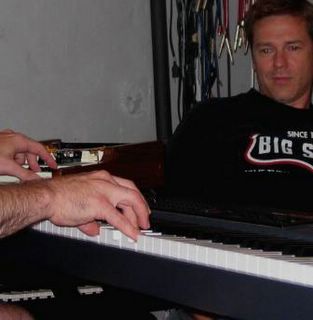
My usual posture: sitting around drooling, while real pros do their jobs.
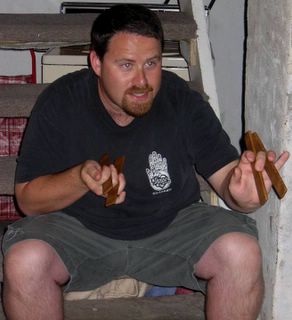
Jay Williamson, warming up his bones for some old-timey percussion.

Dude, he can make those mothers fly.

Mark heats it up with some of the rock, and the roll. We hear it's what the kids are listening to these days.
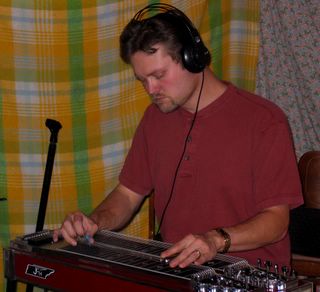
In our attempt to carve our niche in the folky-pop-rock-country genre, we brought in this feller. Dean Holman has played with just about everybody who uses peddle steel guitar ( Ricky Skaggs, Tanya Tucker, Desert Rose Band,etc.) He is considered about the finest steel guitarist in Branson.)
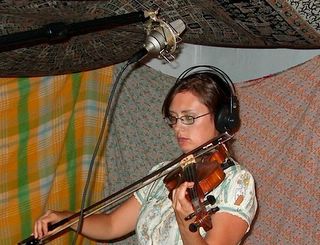
Molly Healey is the proud mother of a beautful baby girl and a beautiful baby CD. We asked her to lend her life-giving powers to our project. Just this side of heaven, I tell you. Just this side of heaven.
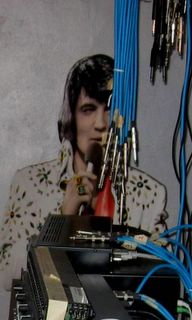
It's good to know the King watches over us.
I mean, everyone needs someone to watch over them.
As for the album, we have entered the mixing stage. This is the period where MayApple maestro Mark Bilyeu performs, what Bill Thomas calls, digital witchcraft. He will take all of our raw ingredients and mismatched tomsongery, mix it with an eye of newt, and boil it in his cauldron. When it's done, beasts will be beautiful, frogs will beg for kisses, Howard Dean will know the difference between the Old and New Testaments, and Karl Rove won't be a meany head. He ain't no Gandalf, but what Mark does for guys like Todd and me is the equivalent of turning Rowling into Tolkien. No, wait, that's not right. It's like turning a sad little writing-in-his-pajamas fantasy blogger into The Lord of the Rings.
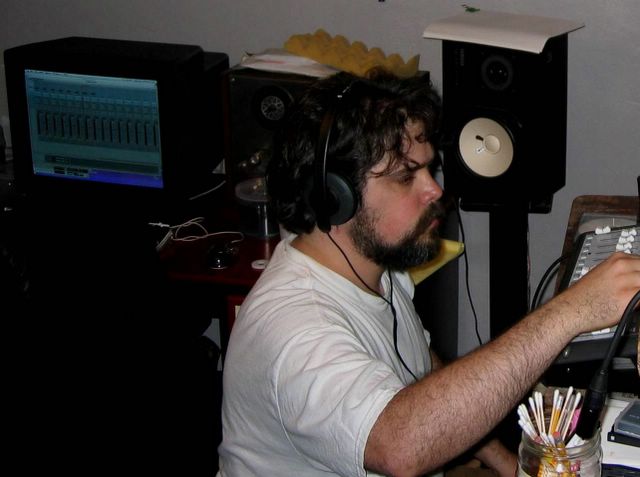
Mark, practicing his dark art.
Actually, magic had some help in this project. We have been incredibly blessed to be joined by some phenomenally talented people. Here they are...

We're thinking about using this photo for the CD cover. It is by Julie Blackmon She is a good friend, and an absolute pro at what she does.
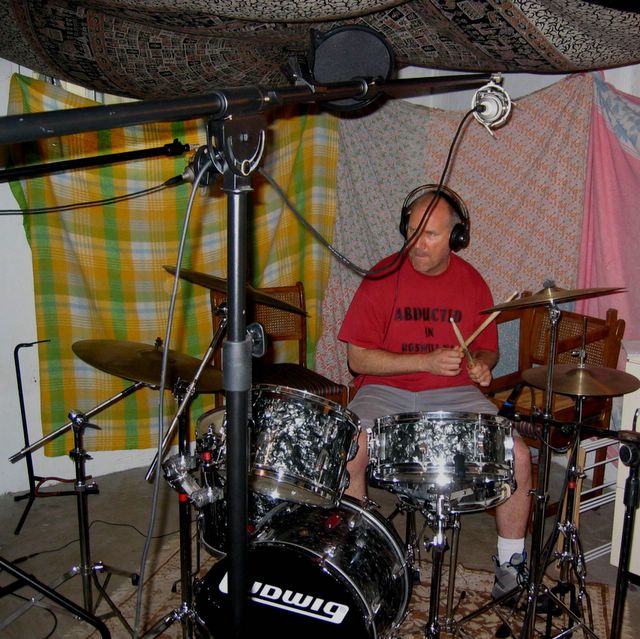
Kenny Wirt played all the drum tracks. He plays with...everybody. He's a rock.

Todd laid down most of the bass tracks. This photo is a reminder that you should never operate heavy machinery while playing funky bass lines.
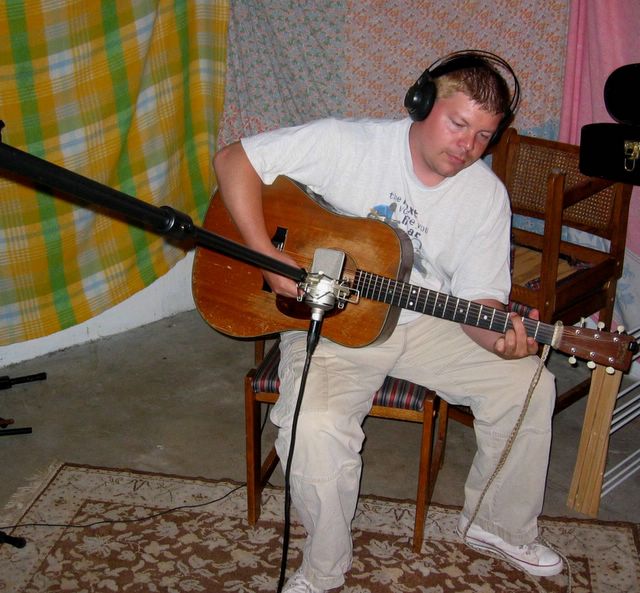
More dreamy flushed looks for Todd? It's the intoxication of playing Mark's '46 Martin.
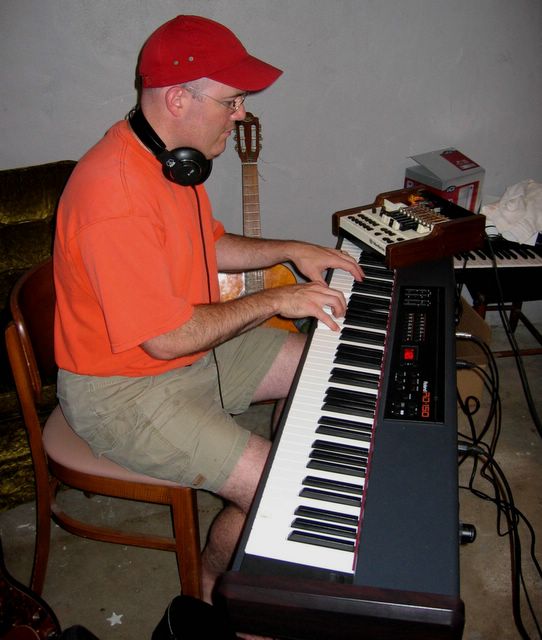
Along with his mandolin licks, Jody Bilyeu, of Big Smith, sure beefed up things with his piano, and Hammond organ virtuosity. Oh, and he taught us how to moosh our own chips.

My usual posture: sitting around drooling, while real pros do their jobs.

Jay Williamson, warming up his bones for some old-timey percussion.
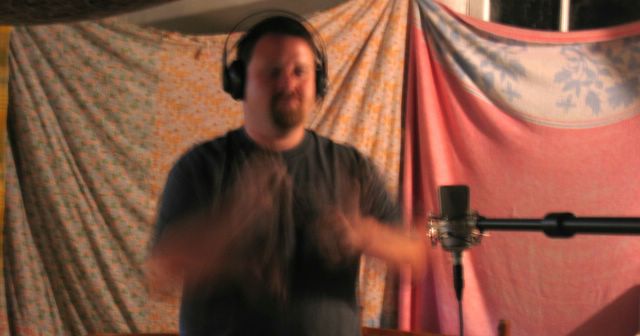
Dude, he can make those mothers fly.
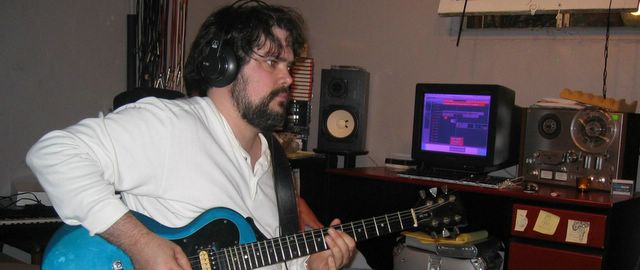
Mark heats it up with some of the rock, and the roll. We hear it's what the kids are listening to these days.

In our attempt to carve our niche in the folky-pop-rock-country genre, we brought in this feller. Dean Holman has played with just about everybody who uses peddle steel guitar ( Ricky Skaggs, Tanya Tucker, Desert Rose Band,etc.) He is considered about the finest steel guitarist in Branson.)

Molly Healey is the proud mother of a beautful baby girl and a beautiful baby CD. We asked her to lend her life-giving powers to our project. Just this side of heaven, I tell you. Just this side of heaven.
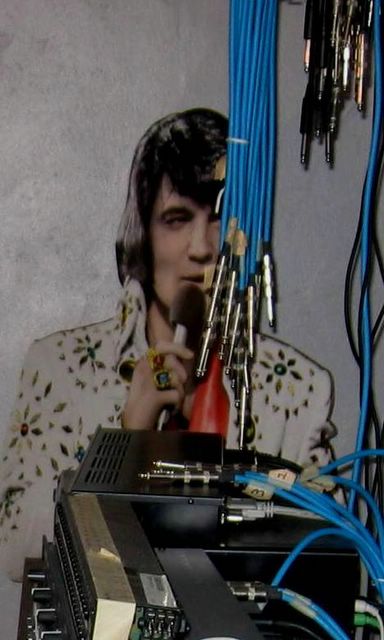
It's good to know the King watches over us.
I mean, everyone needs someone to watch over them.

Tuesday, July 12, 2005
WHERE'S HOLDEN CAULFIELD?
Relax. No Freudian repression, Marxist alienation, or Kierkegaardian angst; just a couple of thoughts. The last time I read the book I was 30-ish; 20-ish the time before that, etc. It’s always interesting to read a book again when you’re a different person. Catcher at 40. Huh.
One of the scenes that caught my attention, this time around, was Holden’s visit to Ernie’s in
It was pretty quiet, though, because Ernie was playing the piano. It was supposed to be something holy, for God’s sake when he sat down at the piano. Nobody’s that good.[...] I’m not too sure what the name of the song was that he was playing when I came in, but whatever it was, he was really stinking it up. He was putting all these dumb, show-offy ripples in the high notes, and a lot of other very tricky stuff that gives me a pain in the ass. You should’ve heard the crowd, though, when he was finished. You would’ve puked. They went mad. They were exactly the same morons that laugh like hyenas in the movies at stuff that isn’t funny. I swear to God, if I were a piano player or an actor or something and all those dopes thought I was terrific, I’d hate it. I wouldn’t even want them to clap for me. People always clap for the wrong things. If I were a piano player, I’d play it in the goddam closet. Anyway, when he was finished, and everybody was clapping their heads off, old Ernie turned around on his stool and gave this very phony, humble bow. Like as if he was a helluva humble guy, besides being a terrible piano player. It was very phony—I mean him being such a big snob and all. In a funny way, though, I felt sort of sorry for him when he was finished. I don’t think he even knows any more when he’s playing right or not. It isn’t all his fault. I partly blame all those dopes who clap their heads off—they’d foul up anybody, if you gave them a chance.
I guess it reminded me of a new TV show I saw last night—Who Wants to be a Rock Star, or Rock Star Idol, or some such crap. All these young people desperately preening, writhing, and wailing to impress the audience and INXS. Rock and roll sure has changed. It used to give the finger to the machine. Now it's a game show.
Not that pleasing an audience is all bad, but at what point to you become a phony because all you’re doing is playing for the applause?
When do the dopes who clap their heads off become the dope you smoke, the drug you need? When does the music, the painting, the writing, or preaching just become another act of prostitution that scores you round of public approval?
Did I just equate preaching with prostitution? Turn to the scene where Holden is having a pleasant conversation with a couple of nuns, and he’s worried they will ask him if he’s Catholic. “Catholics are always trying to find out if you’re a Catholic.”
He narrates a story about a boy he met at the Whooten School. They discovered they shared an interest in tennis, and started having a meaningful conversation.
Then, after a while, right in the middle of the goddam conversation, he asked me, “Did you happen to notice where the Catholic church is in town, by any chance?” The thing was, you could tell by the way he asked me that he was trying to find out if I was a Catholic. He really was. Not that he was prejudiced or anything, but he just wanted to know. He was enjoying the conversation about tennis and all, but you could tell he would have enjoyed it more if I was a Catholic and all. That kind of stuff drives me crazy. I’m not saying it ruined our conversation or anything—it didn’t—but it sure as hell didn’t do it any good.Reminded me of a scene from The Big Kahuna, when Phil Cooper (Danny DeVito) is giving a speech to Bob Walker (Peter Facinelli). Phil is telling the young Baptist, Bob, that whenever he starts selling something, whether it's Jesus or industrial lubricants, he ceases to be a human being and becomes a marketing rep.
Because as soon as you lay your hands on a conversation to steer it, it's not a conversation anymore; it's a pitch.
When religion eclipses relationship, it is inevitable that we will become phonies. Our pitch, and making the sale, become more important than the person in front of us.
Maybe it was Holden’s desire for innocence that struck me differently at this point in my life. He keeps dwelling on this lyrical memory he has, until he is corrected by his kid sister.
You know that song, "If a body catch a body comin' through the rye"?...
It's "If a body meet a body coming through the rye"! old Phoebe said. "It's a poem. By Robert Burns."
Here's the part I think I read differently than I had before.
Anyway, I keep picturing all these little kids playing some game in this big field of rye and all. Thousands of little kids, and nobody's around—nobody big, I mean—except me. And I'm standing on the edge of some crazy cliff. What I have to do, I have to catch everybody if they start to go over the cliff—I mean if they're running and they don't look where they're going I have to come out from somewhere and catch them. That's all I do all day. I'd just be the catcher in the rye and all. I know it's crazy, but that's the only thing I'd really like to be.
I've read this as a teenager and as a teacher of teenagers; but, now that I am the father of teenagers, it hurts more. Our children (collectively, not just mine) are indeed running blindly through the rye, ever closer to the cliffs. The six hours of daily digital recess, combined with our increasing willingness to turn them over to media surrogates and drug-dealing peers makes the rye higher and tighter.
Maybe Holden Caufield helped give us the Beats, Dylan, and the various undulating rhythms of counterculture since. So many rhythms that counterculture has become mainstream and "cool" is entirely coopted by corporate marketing.
Maybe Holden Caulfield isn’t possible anymore. Maybe the closest we can get are trust fund punks who go without bathing for a week and sneer at The Man. Then The Man packages that sneer and sells it back to them on cans of body spray and celebrity-endorsed
Maybe Holden Caufield isn’t what we need. He sure as hell wouldn’t want the job. But we do need a Catcher in the
Tuesday, July 05, 2005
GET YOUR MOTOR RUNNIN'
I hate you.
Don’t take it personally. I don’t really hate you. I hate that I need you.
More to the point, I hate that I need you to like me, or support me in some way. I hate that I have to have a patron. Like a seller needs a buyer, a singer needs an audience, a teacher needs a student, a black market Rolex dealer needs a gullible rube tourist, and, I guess, a blogger needs hits. We all need patrons. And I hate what that does to us. Richard Weaver once said that “language is sermonic…we are all private preachers.” Well, I say we are all private marketing reps. We’ve all got something to sell. And I hate that.
I would like to say that what I write is the ne plus ultra of authentic communication, that I would keep tossing my yawp out into the void whether you were there to read it or not, but honesty would require that I cop to the charge of bullshit. I do this because it connects me to others. As a consequence, you are always in my mind as I craft my message. I would like to get you out of there, but, alas, there you sit - my patron.
I hope that your presence in the process doesn’t corrupt the truth of what I have to say. I hope my desire for your approval never eclipses my need to tell it like I see it. But, I have lived with patronage so long, I’m not sure I would know what truth - unencumbered by rhetoric - would look like if I saw it.
For years I have enjoyed being a teacher. It has its drawbacks (like low pay and commonly unmotivated students), but my paycheck has little to do with whether my pupils like me. I think I ultimately chose education as my profession because of the lower than average position on the patronage scale.
The problem with patronage is that it shapes us. We are created and recreated in the image of our patrons. If we aren’t, we lose - financially, socially, interpersonally, etc. It seems that the freer we are from patronage, the less privilege we enjoy. With the exception of independently wealthy trust fund babies, most of us have to make decisions with one eye on the market. And I hate that.
Which is why I love “Easy Rider.” It reveals both the triumph and tragedy of freedom.

Dennis Hopper and Peter Fonda in Easy Rider
You might find it odd that I would choose the story of a couple of drug-dealing, social-misfitting hippies to make a point about truth and freedom. While I can’t get behind the narcissism of a cross-country trip financed by a drug deal, there’s something about the abandonment of cultural expectation in this archetypal ‘60s film that makes me feel like we were all born to be wild.
What tamed us? Was it our parents? The church? Public schooling? The marketplace? When and why did we choose to become some synthetic approximation of our former selves? Maybe it was our innate need for self-preservation.
When Billy (Hopper) and Wyatt (Fonda), aka Captain America, run into some trouble in a small town, they receive assistance from an alcoholic lawyer, George Hanson (Jack Nicholson), who harbors similar dreams of personal liberation.

Jack Nicholson in Easy Rider
Sitting around the campfire that night, they discuss what it is that makes normal people become so angry when they encounter easy riders.
Dangerous indeed. Hours after that conversation, George is beaten to death at the end of a redneck baseball bat. The end of the movie sees Billy and Wyatt taken out with a couple of shotgun blasts.
I know it’s only a movie, but substitute these scenes with assassins' bullets or crucifixions and the story is much the same: this world has little room for the truly free. In fact, most of us suffer from a chronic case of eleutherophobia: the fear of freedom. Rather than face our fear, we destroy the one who holds the mirror.
What does all this have to do with patronage? Well, I don’t want to die for my hair, or my politics, or my blog. But, I don’t want to live like a shadow either. Maybe I just wish we could all become a little easier riders.
Get your motor runnin’.
Don’t take it personally. I don’t really hate you. I hate that I need you.
More to the point, I hate that I need you to like me, or support me in some way. I hate that I have to have a patron. Like a seller needs a buyer, a singer needs an audience, a teacher needs a student, a black market Rolex dealer needs a gullible rube tourist, and, I guess, a blogger needs hits. We all need patrons. And I hate what that does to us. Richard Weaver once said that “language is sermonic…we are all private preachers.” Well, I say we are all private marketing reps. We’ve all got something to sell. And I hate that.
I would like to say that what I write is the ne plus ultra of authentic communication, that I would keep tossing my yawp out into the void whether you were there to read it or not, but honesty would require that I cop to the charge of bullshit. I do this because it connects me to others. As a consequence, you are always in my mind as I craft my message. I would like to get you out of there, but, alas, there you sit - my patron.
I hope that your presence in the process doesn’t corrupt the truth of what I have to say. I hope my desire for your approval never eclipses my need to tell it like I see it. But, I have lived with patronage so long, I’m not sure I would know what truth - unencumbered by rhetoric - would look like if I saw it.
For years I have enjoyed being a teacher. It has its drawbacks (like low pay and commonly unmotivated students), but my paycheck has little to do with whether my pupils like me. I think I ultimately chose education as my profession because of the lower than average position on the patronage scale.
The problem with patronage is that it shapes us. We are created and recreated in the image of our patrons. If we aren’t, we lose - financially, socially, interpersonally, etc. It seems that the freer we are from patronage, the less privilege we enjoy. With the exception of independently wealthy trust fund babies, most of us have to make decisions with one eye on the market. And I hate that.
Which is why I love “Easy Rider.” It reveals both the triumph and tragedy of freedom.
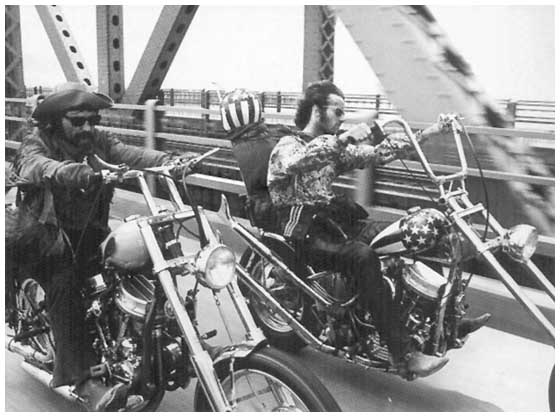
Dennis Hopper and Peter Fonda in Easy Rider
You might find it odd that I would choose the story of a couple of drug-dealing, social-misfitting hippies to make a point about truth and freedom. While I can’t get behind the narcissism of a cross-country trip financed by a drug deal, there’s something about the abandonment of cultural expectation in this archetypal ‘60s film that makes me feel like we were all born to be wild.
What tamed us? Was it our parents? The church? Public schooling? The marketplace? When and why did we choose to become some synthetic approximation of our former selves? Maybe it was our innate need for self-preservation.
When Billy (Hopper) and Wyatt (Fonda), aka Captain America, run into some trouble in a small town, they receive assistance from an alcoholic lawyer, George Hanson (Jack Nicholson), who harbors similar dreams of personal liberation.
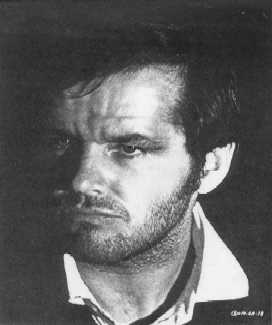
Jack Nicholson in Easy Rider
Sitting around the campfire that night, they discuss what it is that makes normal people become so angry when they encounter easy riders.
Billy: They’re scared, man.
George: Oh, they’re not scared of you. They’re scared of what you represent to ‘em.
Billy: All we represent to them, man, is someone who needs a haircut, man.
George: Oh no, what you represent to them is freedom
Billy: What the hell’s wrong with freedom, man, that’s what it’s all about.
George: Yeah, that’s right, that’s what it’s all about. But talkin’about it and bein’ it—that’s two different things. I mean, it’s real hard to be free when you’re bought and sold in the marketplace. . . . ‘Course don’t ever tell anybody they’re not free, or they’re gonna get real busy killin’ and maimin’ to prove to you they are. Oh yeah, they gonna talk to you, and talk to you, and talk to you about individual freedom, but if they see a free individual it’s gonna scare ‘em.
Billy: Yeah, man, but it don’t make ‘em runnin’ scared.
George: No . . . it makes ‘em dangerous.
Dangerous indeed. Hours after that conversation, George is beaten to death at the end of a redneck baseball bat. The end of the movie sees Billy and Wyatt taken out with a couple of shotgun blasts.
I know it’s only a movie, but substitute these scenes with assassins' bullets or crucifixions and the story is much the same: this world has little room for the truly free. In fact, most of us suffer from a chronic case of eleutherophobia: the fear of freedom. Rather than face our fear, we destroy the one who holds the mirror.
What does all this have to do with patronage? Well, I don’t want to die for my hair, or my politics, or my blog. But, I don’t want to live like a shadow either. Maybe I just wish we could all become a little easier riders.
Get your motor runnin’.
Thursday, June 30, 2005
THE DANGERS OF JOURNALISM
It was late spring, 1981. The classroom was unairconditioned and very hot. It was an introductory journalism class, and I was a bored high school junior. My friend Curtis and I had been amusing ourselves by having a stapler fight. It ended when he stapled my jeans to my leg. Mrs. Wiggins, our teacher, reminded us that our sports stories were due in two days and that we should get to work. Curtis and I eventually huddled up talking about sports and trying to cultivate ideas.
Half an hour later, Curtis drifts over close to Mrs. Wiggins' desk.
He nods in my direction as he whispers, "Mrs. Wiggins, have you heard about the record his dad held in track?"
"No," she says, growing attentive, proud that her students were making the connection between their lives and the assignment.
"Yeah, he ran like a four-minute mile or something. You should ask him about it; he's pretty proud of it."
A few minutes later, Mrs. Wiggins nonchalantly wanders by, smiling.
"I understand your dad held a record in the mile when he was in high school."
I freeze. Nothing moves. I stare at my desk for awhile, while a look of horror creeps across my face. Tears well up as I raise my head to give her a look of pain and complete astonishment. Mouth open.
"M-m-my dad doesn't have any legs," I whisper, plunging my head into my hands, and collapsing onto my desk. My body shakes with sobs.
Off in the corner, Curtis is laughing hysterically and pointing at my poor vulnerable back.
"CURTIS," she screams, red-faced, and getting larger by the moment. She is pissed. Right when she grabs him by the neck to bodily remove him from the room, I fall out of my desk, onto the floor, laughing.
She starts toward me to offer motherly comfort, then sees she has been taken for a ride. It had been a short ride, but the top was down and the pedal had been put to the metal, baby.
Both of us spent some time in the principal's office that afternoon; but it was okay, because for two days we were gods. We were the "no legs" guys that almost gave Mrs. Wiggins a heart attack. It was a sweet rep.
What's the lesson in all this? Be very careful of jouralism. It's a dangerous, dangerous business.
Half an hour later, Curtis drifts over close to Mrs. Wiggins' desk.
He nods in my direction as he whispers, "Mrs. Wiggins, have you heard about the record his dad held in track?"
"No," she says, growing attentive, proud that her students were making the connection between their lives and the assignment.
"Yeah, he ran like a four-minute mile or something. You should ask him about it; he's pretty proud of it."
A few minutes later, Mrs. Wiggins nonchalantly wanders by, smiling.
"I understand your dad held a record in the mile when he was in high school."
I freeze. Nothing moves. I stare at my desk for awhile, while a look of horror creeps across my face. Tears well up as I raise my head to give her a look of pain and complete astonishment. Mouth open.
"M-m-my dad doesn't have any legs," I whisper, plunging my head into my hands, and collapsing onto my desk. My body shakes with sobs.
Off in the corner, Curtis is laughing hysterically and pointing at my poor vulnerable back.
"CURTIS," she screams, red-faced, and getting larger by the moment. She is pissed. Right when she grabs him by the neck to bodily remove him from the room, I fall out of my desk, onto the floor, laughing.
She starts toward me to offer motherly comfort, then sees she has been taken for a ride. It had been a short ride, but the top was down and the pedal had been put to the metal, baby.
Both of us spent some time in the principal's office that afternoon; but it was okay, because for two days we were gods. We were the "no legs" guys that almost gave Mrs. Wiggins a heart attack. It was a sweet rep.
What's the lesson in all this? Be very careful of jouralism. It's a dangerous, dangerous business.
Tuesday, June 28, 2005
NO JUSTIFICATION
Nothing new.
I am sitting here, watching President Bush attempt to justify the war in Iraq. Sad. Very sad. I can't sit idly by while he bobs and weaves to save his skin. Your aggressive move is a sham, sir. You can attempt to divert our attention with red herrings if you wish, Mr. Bush, but you do not make up for the lies upon which you stand.
Justifying the war by detailing all the things you've done since you invaded illegally is not a legitimate argument. You act like the defender of freedom, when you violate international law with your reckless violence.
Do not use the blood of the 9/11 victims to defend your misguided aims. "Your watch" has been wasted. You do not defend freedom. You defend the ideology of the rich and powerful. You defend yourself and your family. You do not defend me.
Don't get me wrong, this is not a partisan issue for me. All you "liberals" out there (Ms. Clinton, Mr. Kerry, and your ilk) that supported this mess from the beginning are equally to blame. Blood is on your hands.
This militarism has been engineered since the early '90s. There is a design to promote democracy through force. I'm not buying it. I'm not buying you, sir. You say, "If evil is not confronted, it rises to face us on another day." I rise to confront you, then, Mr. President. I despise your manipulation of the American people by leading them to believe that lack of support for your violent policies is a rejection of our troops. Shame on you. Shame on you.
Mr. Bush, you say, "We've made progress, but he have a lot more to do." I should say so.
I should say so.
I am sitting here, watching President Bush attempt to justify the war in Iraq. Sad. Very sad. I can't sit idly by while he bobs and weaves to save his skin. Your aggressive move is a sham, sir. You can attempt to divert our attention with red herrings if you wish, Mr. Bush, but you do not make up for the lies upon which you stand.
Justifying the war by detailing all the things you've done since you invaded illegally is not a legitimate argument. You act like the defender of freedom, when you violate international law with your reckless violence.
Do not use the blood of the 9/11 victims to defend your misguided aims. "Your watch" has been wasted. You do not defend freedom. You defend the ideology of the rich and powerful. You defend yourself and your family. You do not defend me.
Don't get me wrong, this is not a partisan issue for me. All you "liberals" out there (Ms. Clinton, Mr. Kerry, and your ilk) that supported this mess from the beginning are equally to blame. Blood is on your hands.
This militarism has been engineered since the early '90s. There is a design to promote democracy through force. I'm not buying it. I'm not buying you, sir. You say, "If evil is not confronted, it rises to face us on another day." I rise to confront you, then, Mr. President. I despise your manipulation of the American people by leading them to believe that lack of support for your violent policies is a rejection of our troops. Shame on you. Shame on you.
Mr. Bush, you say, "We've made progress, but he have a lot more to do." I should say so.
I should say so.
Monday, June 27, 2005
DOES JESUS NEED ACCREDITATION?
Until recently, I served on the accreditation steering committee at the evangelical university where I teach. My responsibility was to help evaluate the organization’s mission and integrity. I resigned from the committee when it became apparent that some in the administration did not desire authentic self-evaluation, and were only interested in accreditation as a marketing device. When I raised questions about an exclusive board of trustees that was entirely appointed by a statewide religious organization, a religion professor who was denied a promotion because of his liberal theology, and our profound lack of racial and ethnic diversity on campus, I was treated like an agitator who was provoking insurrection. It seemed like I was being expected to toe the company line, so I quit.
So, imagine my interest in the recent New Yorker article,
by Hanna Rosin, in which she profiles Patrick Henry College, a fundamentalist Christian school just outside the beltway in Virginia. PHC’s declared mission includes the aim “to prepare Christian men and women who will lead our nation and shape our culture with timeless biblical values and fidelity to the spirit of the American founding.” Not terribly far removed from the mission of numerous Christian colleges. The difference is that PHC is blatantly designed as an incubator for conservative politicos. While the faculty members are well-pedigreed and the students are very smart (many boasting a 1600 on the SAT), the school is heavily endowed by Republican leaders and conservative CEOs who have a vested interest in shaping the country’s ideology. There seems to be a greased conduit from PHC to Capitol Hill and the White House, with Patrick Henry scoring as many internships annually as Georgetown.
Nearly all the students were homeschooled, and come to the college with an evangelical zeal for spreading the fundamentalist gospel of/and conservative Republican ideology. They (or, at least their parents) are also drawn to the extremely rigid moral guidelines and the courtship environment, where romantic relationships are regulated under the watchful eyes of administrators and parents. Students even rebuke each other through campuswide emails for inappropriate displays of affection, or for women tempting their brothers with suggestive attire.
There are only five majors available: government, journalism, literature, history, and classical liberal arts education. The literature major draws mostly women students, who nearly all report that they will not pursue a career, so they can stay home and school their children.
While I would rather play a game of Naked Twister with Karl Rove than send my daughters to such a place, I have no problem with them doing what they do. They have the right to pursue their ideological agenda however they please. What interests me is the manner in which we certify such practices.
What Rosin does not discuss in the article is the problems PHC has had with accreditation. They were denied accreditation by the American Academy for Liberal Education (AALE) based on a biology curriculum that highlights the teaching of six-day creationism (not accepted by the National Academy of Sciences). After breaking ties with the AALE, they finally received accreditation from the Transnational Association of Christian Colleges and Schools, that has certified only about 35 other ultra-conservative institutions. PHC is currently pursuing an application with the Southern Association of Colleges and Schools (SACS), a regional sister to the accrediting body for my university.
If SACS grants them accreditation, it will either mean that PHC has moved away from its militant commitment to a single-minded ideology, or SACS is not fulfilling its declared criteria. Either way, it raises this question: What is the value of accreditation?
If you possess “the truth,” and you are convinced that all your aims are righteous, why would you give a damn about accreditation? I recognize that there are state laws and federal guidelines requiring it, if you accept any kind of support from the government; but it seems like PHC would be quite opposed to any kind of governmental support.
I guess my question concerns the difference between accreditation as compliance/marketing device, and accreditation as communitarian accountability. Receiving accreditation means that your peers at similar universities deem you worthy of certification. If your worldview is so contrary and libertine that you resist any oversight or approval from others, why bother? I suspect that the "more Protestant" an institution, the more reticent it will be to peer-evaluation.
I mean, is it any wonder that those who struggle with accreditation are probably more likely to accuse Democrats of seeking global approval for military acts? By not easily submitting yourself to the review of your academic peers, aren’t you less likely to submit to the will of a body like the U.N.? I don’t think John Bolton is on PHC’s board, but he might be a nice fit.
I am not entirely naïve. I know there are liberal colleges out there doing much the same thing. There are left wing schools where a conservative idea is treated as de facto heresy, and I do not defend them. I find that a repugnant response to the Right. However, in most cases, left-leaning schools demonstrate a greater interest in dialogue and community, where the voice of the minority is structurally—if not always culturally—protected.
So, if Jesus had started a university (perhaps “Fishers of Men Tech”), would he have applied for accreditation. Probably not. And, I suppose, when a faculty and administration reach his level of infallibility they probably don’t need to worry about it either.
So, imagine my interest in the recent New Yorker article,
by Hanna Rosin, in which she profiles Patrick Henry College, a fundamentalist Christian school just outside the beltway in Virginia. PHC’s declared mission includes the aim “to prepare Christian men and women who will lead our nation and shape our culture with timeless biblical values and fidelity to the spirit of the American founding.” Not terribly far removed from the mission of numerous Christian colleges. The difference is that PHC is blatantly designed as an incubator for conservative politicos. While the faculty members are well-pedigreed and the students are very smart (many boasting a 1600 on the SAT), the school is heavily endowed by Republican leaders and conservative CEOs who have a vested interest in shaping the country’s ideology. There seems to be a greased conduit from PHC to Capitol Hill and the White House, with Patrick Henry scoring as many internships annually as Georgetown.
Nearly all the students were homeschooled, and come to the college with an evangelical zeal for spreading the fundamentalist gospel of/and conservative Republican ideology. They (or, at least their parents) are also drawn to the extremely rigid moral guidelines and the courtship environment, where romantic relationships are regulated under the watchful eyes of administrators and parents. Students even rebuke each other through campuswide emails for inappropriate displays of affection, or for women tempting their brothers with suggestive attire.
There are only five majors available: government, journalism, literature, history, and classical liberal arts education. The literature major draws mostly women students, who nearly all report that they will not pursue a career, so they can stay home and school their children.
While I would rather play a game of Naked Twister with Karl Rove than send my daughters to such a place, I have no problem with them doing what they do. They have the right to pursue their ideological agenda however they please. What interests me is the manner in which we certify such practices.
What Rosin does not discuss in the article is the problems PHC has had with accreditation. They were denied accreditation by the American Academy for Liberal Education (AALE) based on a biology curriculum that highlights the teaching of six-day creationism (not accepted by the National Academy of Sciences). After breaking ties with the AALE, they finally received accreditation from the Transnational Association of Christian Colleges and Schools, that has certified only about 35 other ultra-conservative institutions. PHC is currently pursuing an application with the Southern Association of Colleges and Schools (SACS), a regional sister to the accrediting body for my university.
If SACS grants them accreditation, it will either mean that PHC has moved away from its militant commitment to a single-minded ideology, or SACS is not fulfilling its declared criteria. Either way, it raises this question: What is the value of accreditation?
If you possess “the truth,” and you are convinced that all your aims are righteous, why would you give a damn about accreditation? I recognize that there are state laws and federal guidelines requiring it, if you accept any kind of support from the government; but it seems like PHC would be quite opposed to any kind of governmental support.
I guess my question concerns the difference between accreditation as compliance/marketing device, and accreditation as communitarian accountability. Receiving accreditation means that your peers at similar universities deem you worthy of certification. If your worldview is so contrary and libertine that you resist any oversight or approval from others, why bother? I suspect that the "more Protestant" an institution, the more reticent it will be to peer-evaluation.
I mean, is it any wonder that those who struggle with accreditation are probably more likely to accuse Democrats of seeking global approval for military acts? By not easily submitting yourself to the review of your academic peers, aren’t you less likely to submit to the will of a body like the U.N.? I don’t think John Bolton is on PHC’s board, but he might be a nice fit.
I am not entirely naïve. I know there are liberal colleges out there doing much the same thing. There are left wing schools where a conservative idea is treated as de facto heresy, and I do not defend them. I find that a repugnant response to the Right. However, in most cases, left-leaning schools demonstrate a greater interest in dialogue and community, where the voice of the minority is structurally—if not always culturally—protected.
So, if Jesus had started a university (perhaps “Fishers of Men Tech”), would he have applied for accreditation. Probably not. And, I suppose, when a faculty and administration reach his level of infallibility they probably don’t need to worry about it either.
Monday, June 20, 2005
ONE MILLION BAPTISMS
The annual meeting of the Southern Baptist Convention begins tomorrow in Nashville.
I'm all a-twitter. Rosy-cheeked and weak-kneed, I await the genesis of a new day.
I look forward to this event every year. It's more exciting than watching TV or tipping a cow, because you are certain to be entertained. You can absolutely count on the SBC to do something asinine, inflaming the public and distancing themselves even further from the people who need them the most. Whether it is a boycott of Mickey Mouse or another misogynistic assault on women, the hits just keep on coming. This year the convention is set to consider a resolution declaring war on public schools.
Last year some of the SBC leaders proposed a similar measure, but it was just a nebulous attack against godless secularism, so it didn't find traction among the rank and file. This year, co-sponsors of the resolution, Voddie Baucham and Bruce Shortt, are hanging the public school attack on the tried and tested issue of homosexuality. If there's one thing we know will cause Southern Baptists to lunge and froth, it's gays and the gay-lovers who defend them.
It seems that "homosexual activists are aggressively working to transform the moral foundation of our culture," and "any school district that recognizes homosexual clubs or treats homosexuality as an acceptable lifestyle is a clear and present danger to all of its children and is violating the community’s trust." The resolution goes on to advocate a complete exodus from the public schools, creating paranoid enclaves of righteousness in our Christian schools and homes.
Damn gays have to be stopped. If they continue feminizing our children, how will we teach them to torture prisoners and bomb abortion clinics? How will we keep all our uppity women in check if our men get all girly on us? If our children become homosexual, how will they learn to grow up and disgrace the institution of heterosexual marriage at a higher-than-average rate like the rest of us evangelicals?
Bobby Welch, president of the convention, would like to set a goal for this next year of one million new baptisms. It seems that Southern Baptists have experienced a substantial downturn in new converts over the last year or so. I wonder why? Maybe it's because they have strayed so far from Christ's message of unconditional love and forgiveness - in order to advance an aggressive culture war on liberals, infidels, and homosexuals - that the average person sees little difference between them and the people they seem to hate.
Until something fundamental changes, most of the baptisms will be for those who were first immersed in the religion of cultural conservatism, not for those transformed by the extravagant love of God.
I'm all a-twitter. Rosy-cheeked and weak-kneed, I await the genesis of a new day.
I look forward to this event every year. It's more exciting than watching TV or tipping a cow, because you are certain to be entertained. You can absolutely count on the SBC to do something asinine, inflaming the public and distancing themselves even further from the people who need them the most. Whether it is a boycott of Mickey Mouse or another misogynistic assault on women, the hits just keep on coming. This year the convention is set to consider a resolution declaring war on public schools.
Last year some of the SBC leaders proposed a similar measure, but it was just a nebulous attack against godless secularism, so it didn't find traction among the rank and file. This year, co-sponsors of the resolution, Voddie Baucham and Bruce Shortt, are hanging the public school attack on the tried and tested issue of homosexuality. If there's one thing we know will cause Southern Baptists to lunge and froth, it's gays and the gay-lovers who defend them.
It seems that "homosexual activists are aggressively working to transform the moral foundation of our culture," and "any school district that recognizes homosexual clubs or treats homosexuality as an acceptable lifestyle is a clear and present danger to all of its children and is violating the community’s trust." The resolution goes on to advocate a complete exodus from the public schools, creating paranoid enclaves of righteousness in our Christian schools and homes.
Damn gays have to be stopped. If they continue feminizing our children, how will we teach them to torture prisoners and bomb abortion clinics? How will we keep all our uppity women in check if our men get all girly on us? If our children become homosexual, how will they learn to grow up and disgrace the institution of heterosexual marriage at a higher-than-average rate like the rest of us evangelicals?
Bobby Welch, president of the convention, would like to set a goal for this next year of one million new baptisms. It seems that Southern Baptists have experienced a substantial downturn in new converts over the last year or so. I wonder why? Maybe it's because they have strayed so far from Christ's message of unconditional love and forgiveness - in order to advance an aggressive culture war on liberals, infidels, and homosexuals - that the average person sees little difference between them and the people they seem to hate.
Until something fundamental changes, most of the baptisms will be for those who were first immersed in the religion of cultural conservatism, not for those transformed by the extravagant love of God.
Subscribe to:
Posts (Atom)